Thursday, April 13, 2006

a whole lotta bloggy asides

* Sorry I've been away. You may sling rocks and arrows or hurl decomposed tomatoes at me for being a derilect blogger. You may not, however, call me a hipster. Thanks.

* To commemorate the grand opening of my cousin's boutique Grey One in Old Town Pasadena, I'm thinking of dropping a few bucks I recently picked up playing poker on some new kicks. This special ed. Adidas, designed by famed hapa artist Barry McGee, had looked pretty dope, though I now hesitate to pick a shoe that landed on the cover of WaPo as yet the subject of another "Asian stereotype" controversy. Evidently these well-meaning but misguided Asian American activists have never picked a Giant Robot.

(By the way, the content of the above item does not, in any way or form, hint at any hipster-ish tendencies I may or may not possess. So it would not be correct to call me a hipster. Thank you.)

* Wingnut Jonah Goldberg thinks Hollywood finally got it right with Thank You for Smoking. Seems that by portraying Aaron Eckhart's unctious lobbyist as amoral in the public sphere but a Family Guy in private, Hollywood's sending the right message about the wingers and the winger ethos. Dude might be peddling cancer sticks, but hey, don't hate him cuz he a Great Dad! It's not hard to think of Nick Naylor, a WASPy alpha male teeming with confidence, as a kind of idealized Republican, but Goldberg kids himself if he thinks that there are Republicans as attractively self-aware as Naylor. As for the family values stuff, wasn't this supposed to be a cynical satire? Who the hell decided to turn it into a fucking Steven Spielberg film? Memo to Reitman and Buckley: please pick up The Billy Wilder DVD set, and also Ace in the Hole (not included in the set). Watch them and take notes. Thanks.

* I'm not sure about this new Flight 93 movie, but if it's 1/20th as powerful as, say, this news story describing the contents of the flight recorder, it'll be worth catching. Beyond the pleas for mercy, what's most striking for me is how often the terrorists prayed to Allah. Religious nutcases can justify anything in the name of their god, including mass murder.

As for the Moussaoui trial, I thought the prosecutors' theory in applying the death penalty to be a stretch legally, but if anyone deserves execution just for being an evil scumbag, it's this guy. The dude clearly wants to be a martyr, doesn't he? I guess if I had to choose between 70 virgins servicing me in the sweet hereafter vs. a life being confined in utter misery, hated by everyone within a 1000 mile radius, I'd choose the guillotine as well.

* Another story about religious nutcases, this one involving Christianist wackos suing to overturn anti-discrimination laws against gays and lesbians and campus "tolerance" policies. It seems to me quite simple: Christianist wackos' right to *say* whatever the hell they want in the public square should not be abridged by the state. But employers have fairly broad rights over speech content in the workplace. Feeling oppressed cuz your boss won't let you wear your prized "God Hates Fags" t-shirt? Go start your own business, dickhead. Housing and job discrimination policies shouldn't protect gays because it's a "lifestyle choice"? Who says? And your superstitious wankery -- which grants you "special rights," I should add -- is somehow not a "lifestyle choice"?

(Just to be clear, Christianists are not the same thing as Christians. See (the Catholic) Andrew Sullivan for more.)

* The Religious right thinks Christianity is under assault. Muslims think Americans disrespect Islam. Many Jews are worried about widespread anti-Semitism. Yet what is far and away the most unpopular group? Atheists. It's not even close. Try running for public office as an atheist some time. Unless your district is the West Village, you're not getting anywhere. And some courts feel the need to favor the superstitious over the non-superstitious. Read this post by Eugene Volokh, which is like Camus' The Stranger come life. Isn't it rich how some white Christians, who comprise of 70% of the population and occupy 90% of the most powerful positions in this country, constantly whine about being under attack? By 2% of the country who are widely loathed?

* By the way, I once shook Tila Tequila's hand, back when she was merely a Friendster celeb. That Tila Tequila, all 4 foot 10 inches and 72 pounds of her, the one whom Slate has now endorsed for President. (More thoughts on networkng sites later.)

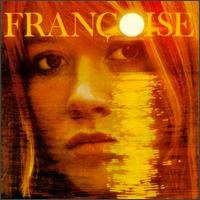
* The faux French band Nous Non Plus, a reincarnation of cult band Les Sans Culottes (the excruciating breakup of which is detailed in Slate), put a fun live show a couple of weeks ago at Spaceland. My Monsieur Gainsbourg Revisited (a Gainsbourg tribute album featuring Portishead, Jane Birkin, Franz Ferdinand, etc. -- though where's Luna's definitive "Bonnie and Clyde"?) is in the mail. The incomparable Francoise Hardy is seeing a new surge in popularity, at least according to Filter. A good time to be 60s Franco-pop enthusiast.

* Rejoice! Criterion will issue Edward Yang's masterpiece Yi Yi in July, in a characteristically awesome cover design. That bodes well for an eventual release of Yang's A Brighter Summer Day, my pick as the greatest film not yet on DVD. (Thanks to Vlad for the tip.)

* Shrouded by a fog of cigarette smoke, Tony Leung sits alone in his French Quarters hotel room, playing John Coltrane and Duke Ellington's "In a Sentimental Mood", unable to shake the memory of lost love as the window shutters swing violently to-and-fro. That was the image my mind conjured up as I happened upon rumors that Wong Kar-wai was planning a Hurricane Katrina movie (it was to star Adrien Brody actually). Let's thank the movie gods that Wanker apparently changed his mind. His new film has nothing to do with Katrina. Vaguely described as a "road movie", My Blueberry Nights will star Norah Jones, Rachel Weisz and Jude Law and will be shooting in various American locations shortly. The description of this project brings to mind Wim Wenders' Paris, Texas and Antonioni's Zabriskie Point, films that heralded an "American period" of these two major foreign masters of mood and atmosphere. Ominously, it ushered in a period that ultimately led to creative paralysis for both. Wanker should do well to keep Tony on call.

His other English-speaking project, the Nicole Kidman period drama The Lady of Shanghai, is being pushed back to next year.

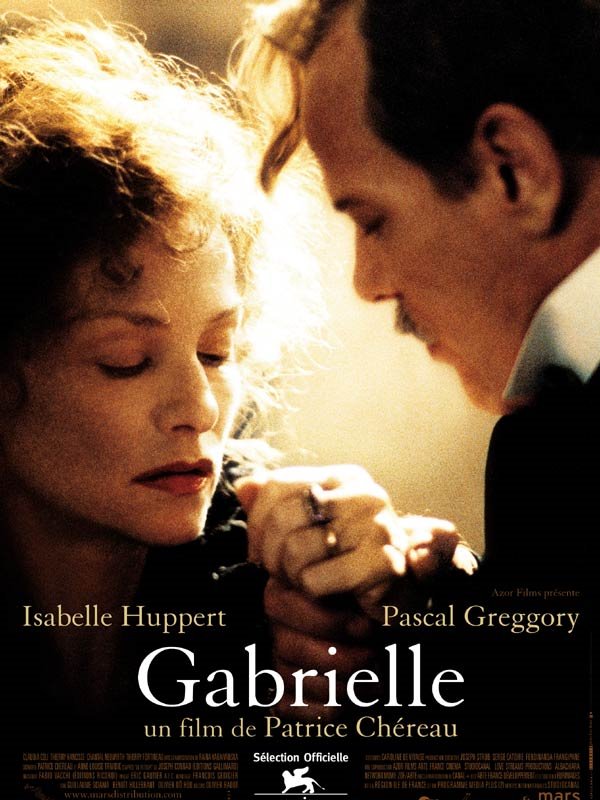
* Patrice Chereau's Gabrielle. Wow. Just wow.

[Thoughts may be forthcoming concerning one of the following topics: (1) Chereau's dazzling formalism and how his gamesmanship -- on screen text, six or seven different lighting schemes -- puts just the right accent on the material; (2) how marriage sucks; (3) a battle of wills between a man who lusts after control and a woman yearning to reliquish control; (4) Huppert's obvious casting - Greggory less so; (5) why so many masterpieces emerge from strong-willed auteurs grappling with canonical 19th century/early 20th century literature; (6) chamber dramas as the most cinematic pictures ever shot -- paradox or not?; (7) comparisons to Love Streams, The Bitter Tears of Petra von Kant, or another cineaste-lauded work that bears a superficial similiarity to the movie under discusson.

Truthfully, I would not count on such thoughts being forthcoming. But if they do come forth, watch for more in this space.]

Wednesday, March 15, 2006

Who is this man?

(a) The bassist for the post-emoelectropunk band The Monterey Park Penis Debacle (not yet formed but already a Pitchfork buzz band!).

(b) A salesman of portable butane stoves who is accused of abducting a missing white woman at a Caribbean resort.

(c) Some ass who used to shoot spitwads at you in geometry class and now works at Leo's Auto Parts.

(d) One of the two best college basketball players in the country.

It's March Madness time, which means the American economy stands to lose up to $3.8 billion in lost productivity as workers obsess over their brackets and click refresh on the live box score a milliion times instead of doing good ol' data entry. The man with the trailer-park moustache on the top-right corner is Adam Morrison, one of leading lights in the resurgence of the Great White Hopes in basketball. He plays for Gonzaga, an overrated team with suspect defense that'll wear down in three tourney games.

Since I've only watched about 2 hours of non-Pac-10, non-Gonzaga NCAA b-ball this year, my bracketology IQ is roughly 53. With the other regions, I'll probably go with a bunch of Big East teams like everyone else. Nobody respects the Pac-10 this year, but UCLA, under Howland, is really clicking and is my pick to emerge from the West. Had the chance to watch the Bruins demolish my beloved Bears at the Staples Center in the Pac-10 tournament championship game last Saturday. Stifling defense coupled with terrific guard play are a tough combination, especially when you've got perimeter shot workin'.

The Cal Bears have a typical Cal team under Ben Braun -- plodding, defense-oriented, probably a 2nd round knockout at best. This year we've got the most dominant player in the Pac-10, sophomore power forward Leon Powe, who figures to at least overpower the smaller NC State. It'll be good to see Powe, a classy, hardworking guy from a very disadvantaged background, get some national publicity and hopefully boost his draft position, especially if he can do well against projected top-3 pick LaMarcus Aldridge of Texas in the 2nd round. But let's not get ahead of ourselves.

[I owe some people responses to dangling threads down below. I'll try to get to them by the end of the day, maybe; a big chunk of my time today will again be spent at Staples as I'll be seeing Kevin Garnett in the flesh for the first time.]

Tuesday, March 07, 2006

Note to world

the term for a sure thing is not shoe-in. It is shoo-in. As in, "gee, I thought Barry Bonds would be a shoo-in for the Hall of Fame." (Not.) Please note for future use. Thanks.

And because it deserves a link: Slate takes on one of the great underdiscussed nuisances of 21st century living, the auto-flush toilet.

Monday, March 06, 2006

A true Hollywoof fairy tale

Hey guys. Have you seen this Myspace movie? It's really, really funny. Check it out.

No, I jest.

The Myspace movie is total crap -- ineptly directed, written and acted, and with one decent joke for its running time (the opening picture-taking). An attempt to lampoon the habits of Myspace users, the movie passes off the kind of trite observations you trade while waiting in line at an amusement park ride. Did you know blurry photos posted on online social networking sites are unreliable? Did you know you shouldn't post stuff on Myspace that you don't want your girlfriend to find out about?

I'd be ashamed to post a blog entry so obvious. But in true Hollywoof fashion, the hack responsible has been rewarded with a deal. I suggest opening a second window or tab to simultaneously work on a sudoku puzzle if you're really curious about watching the thing, just so you won't feel like you'd just wasted eleven minutes of your life.

A lot has been said about the revolution in DIY filmmaking catalyzed by the likes of YouTube. It's lead to the popularity of brilliant amateur work like Brokeback to the Future and the discovery of dudes who made the best SNL spot in ages. Over time, though, I suspect it'll reward mainly folks who can come up with the cleverest promotional gimmick.

Sunday, March 05, 2006

What the...

fuck just happened?

Did the stupid middlebrow no-taste simpleminded-liberal insular no-taste dumbass undiscriminating motherfucking moronic sheep just annointed fucking Crash best picture?!?!?!?!?!?!?!?!?!?!?!!?!?!?!?!!?!?!!?!!?!!?!?!?

[18 hours later...]

Alright, I've calmed down. Here's the thing. I've never even seen Crash, a movie I've tried to stay as far away from as a sneezing chicken. From everything I can glean about it, it sounds like a complete abomination, a haughty, schematic, and simpleminded race-ralations tract that only self-congratulatory Westside liberals can love. Did I just type self-congratulatory Westside liberals? I guess all of those well-paid Oscar prognosticators (is the Oscars really that important that we need a NY Times blog to fill us on the breathless horserace developments?) reading the tea leaves were right that Crash actually did stand a chance.

The level of vitriol that's been unleashed since Crash's Oscar nominations and now win (this Oscar predix piece by Slant's Ed Gonzalez and Eric Henderson is the funniest of the lot), not only from fellow movie nerds (many of whom called it the worst movie of the year, at least one called it one of worst he's ever seen) but also notably from a number of non-movie buffs, has became so histrionic that I've actually grown kinda curious about the movie, in that proverbial you can't avert your eyes from a car crash kinda way. The apogee may be an Oscar gabfest of LA-based film critics, where Larry Mantle, a normally mild-mannered host of a low-heat NPR talk show I listen to, expressed astonishment that Crash, "one of the worst films he's seen in the last two or three years" was even nominated. Imagine Terry Gross going apeshit. It's like that.

Can it really be that awful? It'd be quite an achievement if the movie even approach the singular awfulness of the slow-mo finger-bang-in-front-of-a-burning-car interpretive dance calamity, a number so jaw-droppingly bad it makes the 2002 Lord of the Dance number look like Nijinsky's Rite of Spring by comparison. (I guess it's always possible that this dance folly was a subversive critique of Crash's alleged literal-mindedness. Otherwise: What. The. Fuck.) But if there were any doubts, during his acceptance speech for original screenplay, Paul Haggis said the magic words that confirmed Crash's crappiness. The magic words? "Bertolt Brecht." The last refuge of a hack. For more, see Matt Zoller Seitz's impassioned post, currently Destination A for Crash-haters nursing an Oscar hangover. Checking out Defamer's implosion is kinda fun as well.

Was it homophobia that forestalled the coronation of Brokeback Mountain, the best movie Oscar has nominated in at least eight years? Not being well connected to Academy members, I'm forced to consider the gossip passed on by the usually worthless Nikki Finke. Finke, Ken Turan, and Jeffrey Wells rely on anecodotal evidence to support their claims that no amount of acclaim for Brokeback can overcome many voters' aversion to the idea of watching heavy petting by two dudes in cowboy hats. Perhaps. The other popular theory is that LA votes for well-connected Angelenos. My theory: Oscar voters, as a whole, are generally pretty dumb. Sometimes they do okay (see: 1991, 1993, 1996, 1997, 2004). And sometimes they award Best Picture to dreck like Forrest Gump and Chicago. Get a load of the mind of a typical Oscar voter:
'Crash' was far more representative of the our industry, of where we work and live," said David Cohen, one among hundreds of Hollywood players joining in the festivities. " 'Brokeback' took on a fairly sacred Hollywood icon, the cowboy, and I don't think the older members of the academy wanted to see the image of the American cowboy diminished."
Last night's Oscar telecast reminded us that neither of the two greatest working American directors have a Best Picture or Best Director attached to their work. In a way, Martin Scorsese and Robert Altman are the living embodiment of Oscar's enduring lameness, confirmed by the Best Picture result this year.

The telecast itself was quite superb, I thought, in line with the sentiments expressed here. Stewart's first few jokes were lame and obvious, but he ad-libbed some hilarious lines, including "If you're trying to escape a burning car, my suggestion would be to not move in slow motion." The highlight were the political ad parodies, which were also perhaps the most pronounced "Daily Show"-type gag. Like Scott, I was shocked to wake up to generally poor reviews of Stewart from the mainstream press, many of whom disliked Stewart commenting on his own material or mocking Hollywood politics. Personally, the self-important narcissism of this industry awards show would be difficult to sit through without a gently prodding outsider emceeing. Bob Hope is dead, guys. Pre-irony was so 1994.

Jon Stewart is also my hero for finally popping the most important question in Oscar telecast history: What is the freakin' point of these montages? If the Academy is willing to humiliate award winners to make sure Oscar goes under 3:30, why stock the show with these time-fillers? I don't get it. Who tunes in to the Oscars thinking, man, I can't wait for the montages this year! Do they think that, after seeing a two second clip of "The Day After Tomorrow," I'm suddenly gonna go out and rent the damn thing? Or the biopic montage is somehow going to enter into a sixteen year old's unconscious, only to spring up in unsuspecting moments? ("Hey, let's hold off on XXX: State of the Union. I'm kinda in the mood for a black & white movie about Louis Pasteur.") And those are the interesting selections. Mostly, we have the iPod shuffle of familiar clips: the Jets! Terry Malloy, his face swollen! Chariot race! ET phone home! Tara! Rick and Elsa at the airport! Jack LaMotta in the ring! Chaplin doing the little tap dance! Climb e'vry mountain, Maria! Get up on those steps, Rocky! Kiss Deborah Kerr good, Burt, and watch out for the wave!

Iconic images all. Excellent movies (mostly). But stick 'em in an AFI special, okay? I suggest "the Top 100 Best Shots for Use in an Oscar Montage." The thing is, they're not even very clever montages. Turner Classic Movies shames the Oscars with their monthly montage promo spots, with like a tenth of the budget. Just cut it out already.

Thursday, March 02, 2006

War Supporters: The New Flat-Earth Society

Invading Iraq was an idiotic idea. It was idiotic in 2001, idiotic in 2003, and idiotic today. It was idiotic in 2001 because Saddam wasn't a huge threat and rebuilding Iraq would require resources better used elsewhere. It was idiotic in 2003 for the same reasons, and because we had a clear enemy who attacked us. And it remains idiotic in retrospect.

A good decision-maker first looks honestly at the operative facts, carefully appraises the likely costs and benefits that will result from the decision, and carefully weighs the costs against the benefits. A poor decision-maker only looks at one side (usually benefits) before making the choice. When it comes to going to war, the biggest decision a country can make, the leadership and its people owe it to themselves to make the most sound decision possible.

Let's go through how we should approach going to war. The primary goal for American foreign policy is to maximize the security of the American people. To achieve those goals, the United States focuses on: (1) promoting regional stability; (2) forming strategic alliances with other countries; (3) neutralizing dangerous states and non-state actors, or minimize their chance to do harm; and (4) preventing the spread of weapons and nuclear materials. (Since economic prosperity and stability is the most important aspect of stability, the US promotes policies that increase trade and sustainable growth. And since democracy is the most stable form of government, spreading democracy tends to promote our security interests. Stopping the spread of antagonistic ideologies is also important.) Secondary goals of foreign policy include helping non-Americans in need and helping non-Americans in peril, and increasing the wealth of Americans.

With the goals in mind, let's see where Iraq fits in. In 2003, American policy experts knew that (1) most reliable intelligence suggest Saddam wasn't close to nuclear capability or a potential threat to attack Americans (having unconventional chemical weapons -- the WMDs everyone thought Saddam had -- didn't make him a grave threat to the US itself); (2) Iraq has no connection to Al Qaida; (3) Iraq is a glue-together nation that has serious underlying sectarian divisions; (4) it'll cost a lot of money and manpower to build democratic institutions; (5) most of the world were against invading Iraq as an act of first resort; (6) it's likely Al Qaida will use the invasion of Iraq as demonstration of a "clash of civilizations" and use it as a recruiting tool; and (7) there are more urgent threats to American security that requires our resources and attention.

So the foreseeable costs of the invasion are: (1) hundreds of billions of dollars in invasion and reconstruction; (2) hundreds to thousands of American casualties; (3) increase in jihadism and jihadist recruits; (4) increase in anti-Americanism worldwide; (5) military may be tied down in Iraq; (6) other, more immediate threats attack us or strengthen as our resources are devote to Iraq; (7) the possibility bad-case scenarios arising where a failed nation-state leads to a civil war, throwing the Middle East into turmoil.

The foreseeable benefits of the invasion are: (1) removal of an evil dictator; (2) removal of a threat to our allies in the region; (3) liberation of an oppressed people; (4) Iraq as a forwarding base for American military operations (so we can get our troops out of Saudi Arabia); (5) a stable and secure source for oil exports; and (6) best case scenario of a shining example of a pro-Western Arab democracy in the Middle East (the neocon domino theory, the next logical step, is just too unrealistic to posit here).

When you look at the costs vs. benefits, you see that most of the costs would greatly harm American security and increase uncertainty. The benefits are very helpful but not especially vital to American security. Using cost-benefit analysis, then, it's clearly a poor decision to go to war. We are risking our most important goals (securing the safety of Americans) to achieve secondary goals. It's especially poor because the evidentiary burden of going to war rests with war advocates, as going to war will result in increased uncertainty and risk (the devil we know is usually better than the devil we don't know). And there's the moral burden of ordering people to kill other people. You know, the culture of life we're trying to facilitate here. For both moral and practical reasons, we should resort to war only under the most compelling of cases. Here, in the biggest political decision in the last thirty years, the war supporters don't come close to meeting the burden. If the war weren't a fait accompli, the war's most vocal supporters would have a lot ot answer for.

To illustrate how conceptually unsound the idea of invading Iraq is from its inception, let me posit two scenarios, one abstract game theory, the other an analogy. (Btw, this post recycles and condenses my arguments from a lengthy discussion in the comments section here). The following is copied from this comment:

Let me throw out a game that illustrates the idiocy of this war. Say you have a list that (correctly) evaluates the respective danger posed to you by your enemies. The top enemies are ranked in the following order:

Enemy A - Most dangerous
Enemy B -
Enemy C
Enemy D
Enemy E
Enemy F - Least dangerous but still dangerous

Then you have another list evaluating the probable danger those enemies will pose in 5 years time, which shows the following:

Enemy B
Enemy C
Enemy A
Enemy F
Enemy D
Enemy E

Now, you have security resources totaling 100 units. How do your allocate those resources to maximize your defense/offense against these enemies? US's Iraq policy is akin to the following irrational allocation in this game:

80 Enemy F
5 Enemy A
5 Enemy B
5 Enemy C
5 Enemy D
0 Enemy E

The only way this allocation would make sense is if by defeating Enemy F, you can substantially weaken your other enemies. I don't think anyone can seriously make that case here. This is about as simple a way as I can put it to show how retarded the Iraq Invasion idea was to begin with.

In terms of strategic decision-making, that game illustrates the sheer idiocy of the Iraq invasion. For those not predisposed to attacking Iraq, it was clear that the country was not an urgent threat and not close to being a potentially urgent threat. And in 2003, we hadn't finished the job in Afghanistan. We were still seeking allied support to root out al Qaida members in Europe and Southeast Asia. We had Iran and North Korea, both dangerous countries, seeking nuclear weapons. By allocating resources, I don't mean necessarily invading Iran or North Korea or China. With the $500 billion spent on Iraq[1], we could've dramatically beefed up security on vulnerable targets at home; we could've subsidized Russian scientists so that they won't sell nuclear secrets and materials to rogue countries. We could use soft power to pressure Saudi Arabia to diversify its economy. We could've better subsidize Pakistan's efforts to root out Wahhabism. We could more meaningfully fund opposition groups in Iran. That's not including the opportunity costs.

Or look at it another way:

You're the mayor and sheriff of a town with a crime problem. There's a murderous gang who killed a bunch of residents, but are now in hiding after losing a firefight with your police dept. But you know they're looking to kill again. A couple of crazy dudes in the town might be trying to get their hands on bombs to blow buildings up. Other, not-to-be-trusted types are forming private militias. Then, there are these four ex-cons who've fallen on hard-times: Sam, Kurt, Shane, and Sunny. Sam's the leader and an evil dude. Kurt, Shane and Sunny are just followers, but don't like each other. Now homeless, you suspect they're the culprits of a couple of muggings, using kitchen knives. Maybe if you don't do anything, they'll turn into a formidable crime syndicate one day, though they don't look anywhere close right now.

You've just received an additional $200,000.00 in discretionary funds in your budget for your 15 person police dept. Now you can choose one of the following options:
(1) add three police officers to beef up the police dept.
(2) add two police officers, allocate the rest to security equipment;
(3) add one police, give overtime to the rest, and order them to devote most manpower to preventing the crazies from getting bombs and hunting down the murderous gang;
(4) use the money as assets for undercover work to infiltrate the murderous gang and militia; or
(5) various combinations of the above; or
(6) throw evil Sam in jail on a public indecency charge, and then spend the rest of your discretionary funds on staff for a rehabilitation center where you try to turn Kurt, Shane, and Sunny into responsible citizens, with most of your police officers used primarily to oversee their reform and re-introduction into society.

If you chose (6), congratulations! You've just outed yourself as a war supporter completely incapable of weighing costs against benefits!

Adam and Og in the comments talk about the consequences of "doing nothing." But we had no-fly zones and mandatory weapons inspections. It seemed to work because the non-cherry-picked or non-pressured intelligence analysts at the time did not think Iraq was an imminent or even "clear and gathering threat". Doing nothing means keeping an emasculated, defanged dictator in place. True, that's not a preferred scenario. But it's not preferred that Kim Jong-il is in power, or that Iran elected a lunatic. Good leadership means taking effective and proportionate steps to neutralize potential dangers.

Instead, what we did was take the disproportionate step of going to war with a not-so-dangerous country, which resulted in fomenting hatred of us across the globe, a factory for newly minted and trained terrorists, thousands of dead soldiers, tens of thousands of maimed/injured soldiers, tens of thousands of dead Iraqi civilians, $500 billion dollars ($1 trillion in total costs by some estimates), handcuffing and weakening US military capabilities, and leaving other rogue nations to do their thing.

In exchange, we got rid of Saddam and the Iraqi people -- those who weren't bombed to death, at least -- can now vote. (Saddam killed his own people. The War has resulted in 30,000 Iraqi deaths by reasonable estimations in two years. Was Saddam that much worse?)

Even without the recent spiral into potential civil war, the decision to go to war was categorically and completely wrong. Now, with everything playing out the way many said it would, you have absurd phenomenon of war-supporters continuing to belittle and mock those who were right. It's incredible and bewildering to me how this continues. Consider an analogy: prior to the Olympics, I boorishly exclaimed that Bode Miller would win 5 golds and and mocked anyone who says otherwise as an unpatriotic, anti-American wuss who knows nothing about skiiing. Today, I'm still calling Bode-skeptics anti-American ignorant wusses, except I talk about a conspiracy by the judges to disqualify Miller, or make other lame excuses for Bode's failures. I would be a fucking embarrassment. That's what these guys are like.

Sorry, own up, war supporters. You guys are JUST PLAIN WRONG.

Right on cue, today we have a post that perfectly exemplifies this self-aggrandizing wrongness phenomenon I'm talking about, from Marshall Wittman, the "Bull Moose." If that name sounds familiar, it's because Wittman, a centrist Democrat, is frequently quoted in news stories as an authority on politics. He's supposed to have some credibility. Yet this post is representative of the kind of hysterical, self-congratulatory drivel that war supporters pass off as argument these days. (By contrast, Adam and Og's arguments in the comments section were balanced and thoughtful.) Here's Wittman, quoted in italics:

Some opponents of the war are smugly chortling that "we told you so." Perhaps. But, these opponents do not necessarily occupy the strategic nor moral high ground.

This stuff is rich. Even though opponents of the war were right, they don't "occupy the strategic and moral high ground." We must cede the ground to whom? Wittman? Whose weekly ravings have all the earmarks of a man so fearful of looking "soft" that you suspect he's covering up for certain physical inadequacies? By this reasoning, Galileo's descendants should apologize to the Catholic church. Being right doesn't really matter, you see. Good judgment, strong analysis, good reasoning -- who cares. What does matter? You read guys like the Bull Moose enough, you realize what they care about is "appearing strong". Chest-thumping. A clown like Wittman takes Bill Clinton's maxim that in politics it's better to be wrong and strong than to be weak and right as a moral stance.

As for chortling, well, I for one, don't want to be right. But wanting and assessing are two different things. I want Kings & Queen to win the Academy Award for best picture. But I predict Brokeback Mountain. This is not a difficult distinction, and if we are increasingly vocal about the rightness of our judgment, it's because of boneheaded, speciously argued posts like this one.

"Do they really think that any post-9/11 President would allow Saddam to continue to taunt the West with the possibility of WMD?"

Never mind that this same 9/11 president allows Kim Jong-il to taunt the West with the probability of having nuclear WMD. Never mind that Saddam had nothing to do with 9/11 itself. ("Do they really think that any-post Pearl Harbor President would allow Mexico to continue to taunt the West with the possibility of military aircraft?") And never mind that the "WMD" that really matters -- nuclear weapons and large-scale mobile chemical weapons -- were not weapons that most informed people thought Saddam had. But what do facts have to do with anything? You see, 9/11 gives justification for everything, without consideration to effectiveness, proportionality, or costs. If you're attempting to think clearly and analytically, you're actually in a pre-9/11 mindset.

But
you know what's weird? The Cold War was pre-9/11. During the Cold War, we faced the existential threat of nuclear annihilation. Funny, it seemed like it was even more dangerous back then, and yet none of those great Cold War presidents decided to embark on a reckless policy of regime change by any means necessary.

Do they believe that the realist notion of stability in the Middle East is a solution?

As opposed to Iran exerting influence on Iraq, the spread of radical Islam politically, and the election of Hamas? As opposed to Iraq becoming the recruiting center for Zarqawi and his minions, and where loose munitions and regions of chaos allow for hands-on training for would-be jihadists? As opposed to how things had been going in Iraq, which was in fact a toothless Saddam without WMDs, no Zarqawi presence, or brewing civil war? (Facts are important here.)

And would Iraq and the world really be better with a brutal tyrant still ruling over a country of rape rooms, mass graves and children's prisons?

Is the world better off with more jihadists trained in a terrorist playground with tons of unaccounted-for munitions? Is the world better off with 30,000 people dead? And the world isn't better off with Darfur's continuing genocide, AIDS in Africa, global warming accelerating, etc., that is continuing. For $500 billion dollars, you think we might have done something about those things. You see the dishonest rhetorical tricks (or maybe just plain moronic thinking) deployed by war supporters. It's as if there were no actual cost to the war. It was just about whether you were man enough to go to war or not.

Every decision involves costs, in real costs and opportunity costs. You stake most of the US military, most of the US attention, billions and billions of dollars on one area, you can't use those resources in other areas. If NIH devotes $200 million to researching chest-hair growth potions, that's $200 million that could have gone instead to cancer or Alzheimer's research under a more sensible policy. If the President focuses Americans on the problem of uncontrolled chest hair growth, there's the cost of attention diverted from cancer prevention and the like. It's funny how war supporters always ignoring the cost-side of the equation, as if we don't spend $200 million on chest hair research, that money would just vanish.

Do these war opponents really long for the "good old days" of Saddam's lovely Mesopotamian paradise that posed no earthly threat to the region?


I love how so many war supporters will predictably lapse into this kind of straw man at the end of their nonsensical rants. Did Richard Clarke, the counter-terrorism czar who had advocated strong anti-Saddam measures for decades, really long for the "good old days" when he describes how the invasion of Iraq hurts our national interests and the war against al Qaida? How about Brent Scowcroft, the national security advisor during the first Gulf War? Wes Clark, who spearheaded the Kosovo mission? (Michael Moore should've left that idiotic footage out of his film, but why attack Moore's dumbass point instead of addressing the meritorious ones, like the ones set forth by Clarke?)

Saddam is evil and Iraq was a hellpit. We can all agree on that. But there are plenty of evil people and hellpits in this world -- Iraq is far from the biggest hellpit. Does Wittman or any other war supporter propose spending $500 billion, immeasurable amount of American prestige and goodwill, 2,000+ soldiers lives and untold number of limbs and vital organs, an increase in hatred of America around the world for each hellpit and evil dictator removed? (To be charitable, I'm not even including the increase in jihadists, potential civil war, and other civilian deaths in this equation.) Do we have the responsibility of turning every hellpit into earthly paradise, no matter what the cost?

Give me a break. Folks this WRONG on something this important shouldn't have any credibility. Or they should be allowed to reclaim credibility only after publicly eating crow or issuing an apology. Instead of humility and embarrassment, pea-brained war supporters like Wittman continue to spit out discredited or specious nonsense in a desperate attempt to cast themselves as the force of Macho Manliness opposite those effete anti-war types who don't "get the post-9/11 world." Maybe this kind of blind chest-thumping is what "real men" do. But it takes a more virtuous person to accept responsibility for being so spectacularly WRONG.

In the meantime, the United States is weaker and less secure today as a result of invading Iraq.

[1] The $500 billion is guestimate taking into account this study (showing total economic costs of the war at $1 trillion or more); the 250+ billion already spent, and the current average of $ 6 billion a month for Iraq operations the next three years.

Tuesday, February 21, 2006

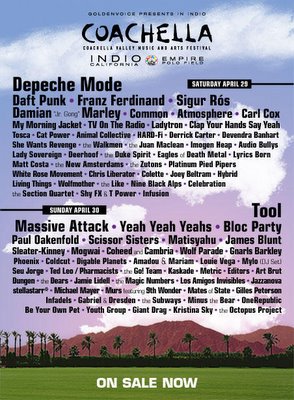
UPDATED: Coachella 2006


After skipping last year's event, I'll be making my third trip in four years to the Coachella Valley Music Festival. A couple of years ago, we had the Pixies reunion. This year...Tool?!? Suffice it to say the lineup hasn't quite blown me away. Only Massive Attack's belated addition can be described as exciting. Come on, Depeche Mode? As for the rest of the lineup, here's how I'd categorize them:

Stoked. Massive Attack, Digable Planets.

Pleased to see them, but not pumped. Franz Ferdinand, Sleater-Kinney, Bloc Party, Common, YYYs, Sigur Ros, Cat Power, Go! Team, Animal Collective, Ladytron, TV on the Radio, Clap Your Hands, Jazzanova.

Like what I've heard. Wolf Parade, Deerhoof, Phoenix, Magic Numbers, The Like, the Walkmen.

Bleh. Paul Oakenfold, Scissor Sisters, My Morning Jacket (though I do have a burnt copy of It Still Moves), James Blunt, Tool, Ted Leo & the Pharmicists, Depeche Mode (though I do own Catching Up...), Daft Punk (though I do own Discovery).

Bands I've seen before: Mogwai, Metric, The Dears, Atmosphere.

Heard of 'em but never heard em. Devendra Banhart, She Wants Revenge, New Amsterdams, the Editors, Art Brut, Amadou & Mariam.

Who? Everyone else.

UPDATE: The Material Girl herself -- yes, Madonna has been added, and she'll be performing in the intimate venue of the tent, no less. A sell-out is now assured. No word on whom she'll tug along as lesbian stage-show partner. (I previously saw Madonna at the Anaheim Pond back in 2004, the blow-by-blow of which was reported here, probably the only okay thing I've ever posted on music, if my judgment on my own writing can be trusted.)

UPDATE II: After listening fairly extensively to the Coachella player, I'm now looking forward to the following acts:

Art Brut: the kind of overhyped Brit post-punk (neo-punk? retro-punk? whatever...) band you approach with caution, but can't help warming to.
Deerhoof: Okay, they officially rule.
Davendra Banhart: Supposedly a highly experimental, genre-crossing mimic, what I heard on the player was just straight- up blues-influenced folk. But the cognescenti's choice, so definitely will have to check him out.
Giant Drag: The "Kevin is Gay" song on the player is super-catchy shoegaze pop, like warmed-over Breeders. I mean that in a good way.
Jamie Lidell: decent but unremarkable soul revival stuff from what I can tell, but it'll be a good break from wimpdie pop since I ♥ the Otis and Sam Cooke stuff the dude appears to be alluding to.
Lyrics Born: Now I remember: This dude was a key contributor to Blackalicious' quite awesome Blazing Arrow and had an acclaimed album come out a couple years back. Still limited exposure, but good enough for me.

Please drop a comment if you've got some dope some of the more obscure bands in the lineup. Thanks.