Friday, May 20, 2005

The Helper Guy

You know the type, the dude of boundless energy all in the service of, well, service. He's the "friend", the guy whom you can rely on to pick up your girlfriend from the airport when you've scored hard-earned tickets to see The Arcade Fire. But you don't make the call to him, she does; because he's not your friend, but her's. I'm talking about the helper guy.

In his native habitat, the helper guy can be anybody: a clown, a jock, a hipster, a worker bee. He's no different than any other guy. But when he develops interest in a woman, the helper side takes over. The helper guy is there to pick up the birthday cake for his "good friend". He'll listen patiently to complaints about co-workers and respond with supportive comments. He'll listen patiently to complaints about the self-absorbed, inattentive boyfriend and respond with supportive comments. He's earnest, kind, helpful, and of course, trapped in the dreaded Friend Zone. Sometimes you appreciate that he's there to deal with shit so you don't have to. But I'm warning you to not get complacent: watch your back. Through sheer willpower, this dude can break free of the Friend Zone and leave you in the dust.

Don't get me wrong: I don't question the sincerity of the helper guy. I'm sure he's genuinely a "nice guy". Often, in other contexts, he's a good friend or even a relative. I've even learned to respect the helper guy, who has proved to be my most common and enduring romantic rival. Or at least his game, even as I mock it mercilessly. The helper guy's m.o. is to go Above and Beyond the Call of Duty. That's especially appreciated when the woman he's vying for is in a relationship or is courted by a guy who coasts on charm. He might bring the woman's ailing grandmother lunch on occasion. Or drive her to some buttfuck nowhere Ikea to return a regrettable desk lamp. The helper guy plays contrasts, and there's nobody a tireless nice guy would rather be the rival of than the lazy, charming cad.

The helper guy may genuinely just feel good helping out. But it's also clear that the helper guy is exploiting what he has -- labor, energy, and willingness to be enslaved -- to compensate for that which he lacks: often charisma, wit, charm, and sex appeal. Intuitively understanding these deficiencies, the helper guy makes it a tortoise-hare match. Slowly but surely plugging away, he shows himself as ever reliable and useful while the charming rake slowly builds up demerits. Too timid to make a move, the helper guy bides his time like a vulture, circling overhead until the contrast turns into his advantage. Then he'll swoop in.

I apologize for the female-objectifying tone of this post, where women are treated as trophies to be awarded to the most deft romantic performer (though that's how it works, isn't it?). Here at Maxim West, we do our best to restrict offensive analogies and metaphors to 3 per post, so be secure in knowing there are no more such comparisons. And perhaps I've been needlessly oblique, waiting until now to provide some examples. But let's have some, shall we?

* The classic illustration of this dynamic is to be found in
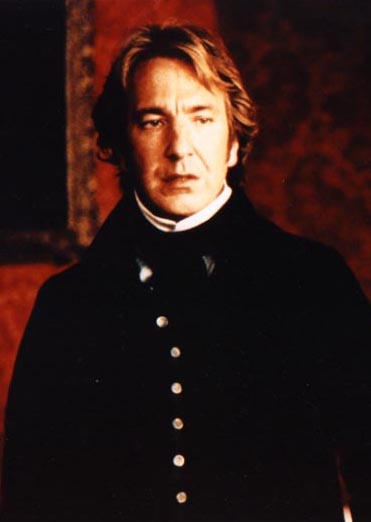
(where else?) Jane Austen's Sense and Sensibility. Willoughby is a dashing young rogue, the kind of guy who sweeps women off their feet. He's also a dastardly rake, which is revealed over time. Time also reveals that helper guy Colonel Brandon, well-intentioned, noble, and dependable (but also morose, colorless and generates no sexual tension whatsoever), is the right guy for Kate Winslet (!!!).

Hmm.

* But the dynamic depends on the teller. Howard Hawks
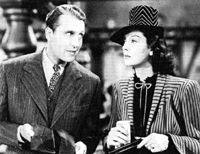
wasn't a worshipper of bland earnest types, and so my personal favorite illustration of right guy/wrong guy, His Girl Friday, finds the helper guy as a boring, helpless dolt, as personified by Ralph Bellamy (whom I had previously miscategorized as a tool).
Though initially won over by Bellamy's like-a-rock reliability, the woman of my celluloid dreams, Hildy Johnson, finally re-succumbs to the conniving ways and quick wit of Cary Grant. You get the feeling Hildy might've had faced less drama if she'd taken that train to Albany, but will she find fulfillment as an Albany housewife to an insurance salesman? I think not.

* Other examples: Helper guys: Colin Firth in almost anything, David Schwimmer's Ross in Friends, Nora's airline ticket-buying, funeral-arranging fixer boyfriend in Kings & Queen, and countless others.

The helper guy can wear you down. By remaining ubiquitous and available, like a 24-hour 7-Eleven, he proves himself indispensable. By earning the woman's trust and listening to her gripes about her relationship, he can pick up enough information to write a step-by-step instruction pamphlet to win the woman's heart. And by being patient and stolid, he exposes you as the self-absorbed, inattentive, commitment-phobic man-child that you probably are.

In short, if you're...
(a) a helper guy, be patient: keep plugging away, bud, you'll win at the end.
(b) a girl with a helper guy, keep using him. He'll keep being used. And maybe you'll discover that he's not that bad. Kissing him won't be as gross as kissing your little brother.
(c) a girl without a helper guy. Go find one. I think Craig's List is supposed to launch a category called "Seeking Helper Guys" in June.
(d) the rival to the helper guy, you are probably thankful for the helper guy right now. He makes your life easier by doing things so you won't have to. Don't be thankful. Drive his ass out of your girlfriend's life now. Poison the well. Make fun of his pants. Insinuate that he's impotent. De-sexualize this dude completely before he finally overtakes you by being so inhumanly patient.

Do it now, before it's too late. Remember, the helper guy is not your friend.

Thursday, May 19, 2005

Appetizer for Kings and Queen

My girlfriend Jo will be happy to know that Arnaud Desplechin's Kings & Queen, which will almost certainly be my number 1 movie of 2005, opens in LA tomorrow. She'll soon no longer have to endure my constant whining, much like a ravenous child demanding a third Sausage McMuffin, about my "insatiable need" to see Kings & Queen again immediately. Hopefully, a second viewing will fill out the nascent thoughts sitting in my draft folder, leading to an actual substantive post sometime this year.

One little nugget for discussion: Is Emmanuelle Devos really that hot? I'm pouring through the numerous raves of the movie from the critics (it appears to be the most rapturously received talky French movie since the heyday of Eric Rohmer, and deservedly so), and the most hyperbolic review of all -- Andrew O'Herir in Salon ("This is a movie you'll carry with you the rest of your life, maybe the way you carry "Fanny and Alexander" or "Vertigo" or "Berlin Alexanderplatz" or "Wings of Desire" or "Chungking Express" or, you know, fill in the blank yourself. It's really that good.") -- builds a review around the proposition that Emmanuelle Devos is blindingly beautiful, an incandescent object of physical perfection a la Catherine Deneuve.

To which I can only say, huh? I will bow to nobody save Chris Stults in my admiration of Devos as an actress, but is she even supposed to be hot?
I've always thought Desplechin positioned her as a kind of more prosaic ("Leda" allusion aside) alternative to the more conventionally beautiful Marianne Denicourt (photo right) or even my own eccentric favorite, Chiara Mastrioanni.

Sorry to get all Maxim here, but Devos' plainness always seemed to me to be integral to the kind of roles she plays, especially in My Sex Life. And it is too a valid question -- my understanding of My Sex Life would be completely different if Devos is meant to be an consensus "hot" type.

One link

Haven't been compelled to blog for a host of reasons, but this I have to pass this along just because this exchange is so satisfying. The army's facing severe recruiting shortfalls. Iraq remains mired in insurgency. And in this country, we have chickenshit Young Republicans and their idiotic bullshit.

Volunteer or shut the fuck up, you fucking wingnuts. Sorry for the profanity, but these "support the troops"-sticker-pasting, immigrant-maid-pampered, hypocritical, couch combatting, war-mongering, fantasy-world-living white nutbag pussies need to be spanked at least six times a day and nine on Sundays.

Wednesday, May 11, 2005

Los Angeles Plays Itself

There once lived a theorist by the name Theodor Adorno. Adorno got his Ph.D. in bitching, and so he bitched and bitched about Hollywood and jazz and the entire culture industry. (If he'd been born 70 years later, he'd host a popular blog.) Adorno, you see, thought mass culture was a tool of late capitalism to distract the proletariat from the true social conditions. But what can an intellectual do about the inexorable machinations of capitalism except bitch?

I kept hearing Adorno's hectoring voice as I watched Thom Anderson's bitchfest Los Angeles Plays Itself (B). Unlike Adorno, Anderson's tone is drily ironic; but like the great German thinker, he views movies through the lens of the neo-Marxism of the Frankfurt School. For folks like Adorno and Anderson, the idea of a "dream factory" is precisely what's wrong with Hollywood, which tries to replace the underlying social reality with the comforts of myth and fantasy.

I must first admit that I have only limited sympathy for this perspective, the idea that pop art must reflect, capture, or reveal underlying material conditions. (For a more sympatico take, go here.) Anderson's perspective diametrically opposes my own art for art's sake inclinations, which is perhaps personalized by quotes from Anderson bĂȘte noire David Thomson in this movie, and I tend to yawn at applied theory (once you're familiar with the theory and the subject, the argument writes itself). My deep disagreement with this perspective perhaps handicapped my enjoyment of Anderson's film. But even on its own terms, the film too often wanders astray. A flabby middle section, which included a lengthy and pointless digression of how one can observe the physical changes in gas stations and supermarkets through the background of pop ephemera, could have easily been trimmed by thirty minutes. (Attempts at free-flowing Chris Marker-like musings don't really jibe with the argumentative structure.) Anderson's archaeology unearths the real Los Angeles existing on the margins of forgettable features; but he needed to throw in random bits of nostalgia for good measure. I'd also be happy with about 70% less of the free-range critical-theory-by-the-numbers ranting Anderson serves up. The meat of the film -- a deconstruction of LA myths as perpetuated by certain canoncal films -- gives food for thought, but it's bizarre that Anderson expresses so much dismay with the "cynicism" of Chinatown and L.A. Confidential. Anderson views these films as origin myths that ultimately show the futility of action to defeat power. But if anything, doesn't his own film traffic in cynicism, in the hopelessness of film as an artform that can capture truth? Anderson's solution is to end his film on an optimistic note, with a few choice clips from independent African-American features from the 70s, including Charles Burnett's astounding Killer of Sheep (a new blow-up print of which I saw last week). This is supposed to suggest that true art can emerge from this cesspool, but the scarcity of these clips -- and the obscurity of Anderson-approved movies like The Exiles -- leave the fledgling artist little hope to ever make a mark. "Forget it, Charles, it's Hollywood", you want to tell the idealistic filmmaker after seeing Anderson's whiny tract.

But like Anderson, I'll end this on an positive note. Not having read any city histories of my hometown, I was gratified to have learned so much -- about how they really got water over here, about the history of Bunker Hill, about the LAPD, etc. Anderson's ideas about the depiction of public transit and modern architecture in movies were thoughtful and highly developed. In the end, I don't expect to see another documentary/essay-film this year as thought-provoking as this one, and for that I'm grateful.

Thursday, April 21, 2005

Favorite directors

As a child, I fervently rooted for Tom to beat Jerry. I desperately wanted Wile E. Coyote to catch Road Runner, and even rooted for the would-be ghosts to get away from Scooby and the gang. Besides explaining the enduring appeal of The Empire Strikes Back and my masochistic adoption of the Red Sox, I'm not sure what this means, or why I'm relaying it on the blog. I'm a Democrat, so it's not as if I'm naturally inclined to root for villains. Perhaps it's a preternatural disposition to subverting formula? A way to trace my tastes to childhood inclinations as a way to impress girls? I'm not sure. I like to think my taste for genre tweaking has been with me from the get-go, which is a way to segue into every nerd's favorite activity, listmaking. Rick Curnutte ran a poll of the favorite twenty-five directors among some movie nerds recently, to which I had planned on contributing but forgotten to do so amid the recent anti-fanboy outburst. So instead I'll post it here, fully aware that no one really cares about other people's lists. But it's the New Positivity, man. Come along for the ride.

The elements that most of these directors have in common are: (1) the aforementioned finding fresh ways to tweak genres/formulas; (2) ravishingly baroque visuals accompanied by lush musical scores; (3) unsentimental but balanced treatment of characters - a key thing for me (and is not necessarily "humanism"); (4) a general air of tragic romanticism; (5) "lyricism," whatever that means; (6) themes of love/time un-regained, or imprisonment by society, especially if those themes are explored together; (7) a sense of liberating play with form; and last but not least, (8) a sense of humor.

Top Ten (in very rough estimated intuitive not-set-in-stone preferential order)

01. Howard Hawks
02. Jean-Luc Godard (1960-1967)
03. Alfred Hitchcock
04. Wong Kar-wai
05. Josef von Sternberg
06. Billy Wilder
07. Martin Scorsese
08. Eric Rohmer
09. Yasujiro Ozu
10. Jacques Demy

Comment: Please worship these guys. They are all awesome, even if not everything they have ever made is awesome.

Next fifteen (rough chronological order) [Not exactly full of surprises]:

F.W. Murnau
Jean Renoir
Orson Welles
Kenji Mizoguchi
Otto Preminger [very underrated - a recent retro helped tremendously]
Douglas Sirk
Alain Resnais [possibly the greatest living filmmaker, all things considered]
Stanley Kubrick
Sergio Leone
Roman Polanski
R.W. Fassbinder
Robert Altman
Brian De Palma [in spite of all the crap]
Edward Yang
Olivier Assayas

Another time, another place: Woody Allen

Sorry to leave out all kinds of great filmmakers, but especially: Buster Keaton, Lubitsch, Preston Sturges (a better screenwriter than director), Lang, Nick Ray, Kurosawa, Naruse, Boetticher, Imamura, [Visconti], Truffaut, and Coppola.

Ten Favorite working filmmakers not listed above (whose new movies I most eagerly anticipate):

01. Charlie Kaufman [yeah, I know]
02. Terry Gilliam
03. David Lynch
04. Arnaud Desplechin [moved up since yesterday]
05. Steven Soderbergh
06. Pedro Almodovar
07. Jim Jarmusch
08. Quentin Tarantino
09. P.T. Anderson
10. Hong Sang-soo & Claire Denis

Stay positive, folks! More good vibes coming your way soon. Unless John Bolton is confirmed as Ambassador to the U.N. Then all bets are off.

Friday, April 15, 2005

One more thing...

Trolling for reviews of The Disappoinment Artist just now, I happened upon a review of recent Lethem works by John Leonard in the NY Review of Books. If this pompous ass is what the anti-fanboy should sound like, well, Make Mine Marvel. Please.

Short and sweet

* To whomever used this site to nuke Pigs & Buttercups: bud, you need help. Anger management has helped Milton Bradley, and it can help you. Funny gag, though.

* My New Republic post of the month: not tired of talk about fanboys yet? Elbert Ventura makes a good case for why Oldboy is not just a fanboy wankjob. Speaking of Ventura, TNR appears to be grooming him as a replacement for the venerable (read: 184-year-old) Stanley Kauffmann, a formerly esteemed critic who has now sadly faded into irrelevancy. The young, adventurous Ventura's a good choice to make TNR film coverage vital again. Not sure if these links work for nonsubsribers, but if you can, check out this ode to Wong Kar-wai and this nerdy attack on the National Society of Film Critics' parochialism for a sample of his work.

* I placed 15th at a 1,600 entry freeroll Party Poker tourney the other day, which netted me a cool $18.00. Freerolls are basically a big waste of time, but it was good experience for further adventures in big multi-table tourneys. (I had finished out of the money in the two other times I tried 500+ player tourneys.) One lesson learned: Even though I dig Daniel Negreanu's style, I'm gonna stick with the easiest way to play big tourneys, which is the T.J. Cloutier-tight style. Wait for a monster and build your stack against fish, which comprise of about 50% of these players (types who will re-raise all-in a big raise pre-flop with KQs or 66). Negreanu's approach requires consistently outplaying your opponents after the flop, which I'm not skilled enough to do just yet. Right now, my overlay at my stakes level comes from being able to make big folds and use selective aggression better than some others.

* One basic poker principle I have only recently picked up on. In late position, it is better to call with 76 suited with limpers in front than if you're holding QJo. You try to bust'em or fold with hands like this, not risk your stack by going for top pair marginal kicker.

* Speaking of Negreanu, I think this article is pretty right on. Asian poker players are getting dissed, though admittedly, most Asians who are poker fiends tend to fall on the FOBby or the quiet nerd side, making them far less marketable than your Daniel Negreanus and Chris Fergusons. Still, as in the case with demographically-unrealistic hospital dramas, it's pretty lame that Tilt, the ESPN poker drama, has no Asians. (Have the producers stepped into a cardroom lately?) A character like my brash young poker fiend cousin Eric would be nice, but they'll probably cast Devon Aoki as a silent-but-deadly type to fill the quota.

* Lastly, thanks to Josh Rothkopf for alerting me to the awesomeness of Jonathan Lethem's book of collected short essays, The Disappointment Artist, which limns the nexus between cultural obsession and autobiography. It's really about the pathology of being a geek, and few books have offered such satisfying (and mortifying) jolts of self-recognition. His description of what it's like to prematurely revere a film (in his case The Searchers) before he's ever even seen it, then having to endure all those who would mock the Western's dated Hollywood conventions, is perfect. And I loved how, in arbitrarily adopting 2001: A Space Odyssey as his new favorite movie, he tried to watch the Kubrick opus 22 times to overtake the number of times he watched Star Wars, only to finally realize that logging most viewings of a particular movie doesn't really mean that much, even in one's internal heirarchy. There's also some good stuff on Jack "King" Kirby. A fine read for cultural obsessives who've read all the Nick Hornbys twice over.