Invading Iraq was an idiotic idea. It was idiotic in 2001, idiotic in 2003, and idiotic today. It was idiotic in 2001 because Saddam wasn't a huge threat and rebuilding Iraq would require resources better used elsewhere. It was idiotic in 2003 for the same reasons, and because we had a clear enemy who attacked us. And it remains idiotic in retrospect.
A good decision-maker first looks honestly at the operative facts, carefully appraises the likely costs and benefits that will result from the decision, and carefully weighs the costs against the benefits. A poor decision-maker only looks at one side (usually benefits) before making the choice. When it comes to going to war, the biggest decision a country can make, the leadership and its people owe it to themselves to make the most sound decision possible.
Let's go through how we should approach going to war. The primary goal for American foreign policy is to maximize the security of the American people. To achieve those goals, the United States focuses on: (1) promoting regional stability; (2) forming strategic alliances with other countries; (3) neutralizing dangerous states and non-state actors, or minimize their chance to do harm; and (4) preventing the spread of weapons and nuclear materials. (Since economic prosperity and stability is the most important aspect of stability, the US promotes policies that increase trade and sustainable growth. And since democracy is the most stable form of government, spreading democracy tends to promote our security interests. Stopping the spread of antagonistic ideologies is also important.) Secondary goals of foreign policy include helping non-Americans in need and helping non-Americans in peril, and increasing the wealth of Americans.
With the goals in mind, let's see where Iraq fits in. In 2003, American policy experts knew that (1) most reliable intelligence suggest Saddam wasn't close to nuclear capability or a potential threat to attack Americans (having unconventional chemical weapons -- the WMDs everyone thought Saddam had -- didn't make him a grave threat to the US itself); (2) Iraq has no connection to Al Qaida; (3) Iraq is a glue-together nation that has serious underlying sectarian divisions; (4) it'll cost a lot of money and manpower to build democratic institutions; (5) most of the world were against invading Iraq as an act of first resort; (6) it's likely Al Qaida will use the invasion of Iraq as demonstration of a "clash of civilizations" and use it as a recruiting tool; and (7) there are more urgent threats to American security that requires our resources and attention.
So the foreseeable costs of the invasion are: (1) hundreds of billions of dollars in invasion and reconstruction; (2) hundreds to thousands of American casualties; (3) increase in jihadism and jihadist recruits; (4) increase in anti-Americanism worldwide; (5) military may be tied down in Iraq; (6) other, more immediate threats attack us or strengthen as our resources are devote to Iraq; (7) the possibility bad-case scenarios arising where a failed nation-state leads to a civil war, throwing the Middle East into turmoil.
The foreseeable benefits of the invasion are: (1) removal of an evil dictator; (2) removal of a threat to our allies in the region; (3) liberation of an oppressed people; (4) Iraq as a forwarding base for American military operations (so we can get our troops out of Saudi Arabia); (5) a stable and secure source for oil exports; and (6) best case scenario of a shining example of a pro-Western Arab democracy in the Middle East (the neocon domino theory, the next logical step, is just too unrealistic to posit here).
When you look at the costs vs. benefits, you see that most of the costs would greatly harm American security and increase uncertainty. The benefits are very helpful but not especially vital to American security. Using cost-benefit analysis, then, it's clearly a poor decision to go to war. We are risking our most important goals (securing the safety of Americans) to achieve secondary goals. It's especially poor because the evidentiary burden of going to war rests with war advocates, as going to war will result in increased uncertainty and risk (the devil we know is usually better than the devil we don't know). And there's the moral burden of ordering people to kill other people. You know, the culture of life we're trying to facilitate here. For both moral and practical reasons, we should resort to war only under the most compelling of cases. Here, in the biggest political decision in the last thirty years, the war supporters don't come close to meeting the burden. If the war weren't a fait accompli, the war's most vocal supporters would have a lot ot answer for.
To illustrate how conceptually unsound the idea of invading Iraq is from its inception, let me posit two scenarios, one abstract game theory, the other an analogy. (Btw, this post recycles and condenses my arguments from a lengthy discussion in the comments section here). The following is copied from this comment:
Let me throw out a game that illustrates the idiocy of this war. Say you have a list that (correctly) evaluates the respective danger posed to you by your enemies. The top enemies are ranked in the following order:
Enemy A - Most dangerous
Enemy B -
Enemy C
Enemy D
Enemy E
Enemy F - Least dangerous but still dangerous
Then you have another list evaluating the probable danger those enemies will pose in 5 years time, which shows the following:
Enemy B
Enemy C
Enemy A
Enemy F
Enemy D
Enemy E
Now, you have security resources totaling 100 units. How do your allocate those resources to maximize your defense/offense against these enemies? US's Iraq policy is akin to the following irrational allocation in this game:
80 Enemy F
5 Enemy A
5 Enemy B
5 Enemy C
5 Enemy D
0 Enemy E
The only way this allocation would make sense is if by defeating Enemy F, you can substantially weaken your other enemies. I don't think anyone can seriously make that case here. This is about as simple a way as I can put it to show how retarded the Iraq Invasion idea was to begin with.
In terms of strategic decision-making, that game illustrates the sheer idiocy of the Iraq invasion. For those not predisposed to attacking Iraq, it was clear that the country was not an urgent threat and not close to being a potentially urgent threat. And in 2003, we hadn't finished the job in Afghanistan. We were still seeking allied support to root out al Qaida members in Europe and Southeast Asia. We had Iran and North Korea, both dangerous countries, seeking nuclear weapons. By allocating resources, I don't mean necessarily invading Iran or North Korea or China. With the $500 billion spent on Iraq[1], we could've dramatically beefed up security on vulnerable targets at home; we could've subsidized Russian scientists so that they won't sell nuclear secrets and materials to rogue countries. We could use soft power to pressure Saudi Arabia to diversify its economy. We could've better subsidize Pakistan's efforts to root out Wahhabism. We could more meaningfully fund opposition groups in Iran. That's not including the opportunity costs.
Or look at it another way:
You're the mayor and sheriff of a town with a crime problem. There's a murderous gang who killed a bunch of residents, but are now in hiding after losing a firefight with your police dept. But you know they're looking to kill again. A couple of crazy dudes in the town might be trying to get their hands on bombs to blow buildings up. Other, not-to-be-trusted types are forming private militias. Then, there are these four ex-cons who've fallen on hard-times: Sam, Kurt, Shane, and Sunny. Sam's the leader and an evil dude. Kurt, Shane and Sunny are just followers, but don't like each other. Now homeless, you suspect they're the culprits of a couple of muggings, using kitchen knives. Maybe if you don't do anything, they'll turn into a formidable crime syndicate one day, though they don't look anywhere close right now.
You've just received an additional $200,000.00 in discretionary funds in your budget for your 15 person police dept. Now you can choose one of the following options:
(1) add three police officers to beef up the police dept.
(2) add two police officers, allocate the rest to security equipment;
(3) add one police, give overtime to the rest, and order them to devote most manpower to preventing the crazies from getting bombs and hunting down the murderous gang;
(4) use the money as assets for undercover work to infiltrate the murderous gang and militia; or
(5) various combinations of the above; or
(6) throw evil Sam in jail on a public indecency charge, and then spend the rest of your discretionary funds on staff for a rehabilitation center where you try to turn Kurt, Shane, and Sunny into responsible citizens, with most of your police officers used primarily to oversee their reform and re-introduction into society.
If you chose (6), congratulations! You've just outed yourself as a war supporter completely incapable of weighing costs against benefits!
Adam and Og in the comments talk about the consequences of "doing nothing." But we had no-fly zones and mandatory weapons inspections. It seemed to work because the non-cherry-picked or non-pressured intelligence analysts at the time did not think Iraq was an imminent or even "clear and gathering threat". Doing nothing means keeping an emasculated, defanged dictator in place. True, that's not a preferred scenario. But it's not preferred that Kim Jong-il is in power, or that Iran elected a lunatic. Good leadership means taking effective and proportionate steps to neutralize potential dangers.
Instead, what we did was take the disproportionate step of going to war with a not-so-dangerous country, which resulted in fomenting hatred of us across the globe, a factory for newly minted and trained terrorists, thousands of dead soldiers, tens of thousands of maimed/injured soldiers, tens of thousands of dead Iraqi civilians, $500 billion dollars ($1 trillion in total costs by some estimates), handcuffing and weakening US military capabilities, and leaving other rogue nations to do their thing.
In exchange, we got rid of Saddam and the Iraqi people -- those who weren't bombed to death, at least -- can now vote. (Saddam killed his own people. The War has resulted in 30,000 Iraqi deaths by reasonable estimations in two years. Was Saddam that much worse?)
Even without the recent spiral into potential civil war, the decision to go to war was categorically and completely wrong. Now, with everything playing out the way many said it would, you have absurd phenomenon of war-supporters continuing to belittle and mock those who were right. It's incredible and bewildering to me how this continues. Consider an analogy: prior to the Olympics, I boorishly exclaimed that Bode Miller would win 5 golds and and mocked anyone who says otherwise as an unpatriotic, anti-American wuss who knows nothing about skiiing. Today, I'm still calling Bode-skeptics anti-American ignorant wusses, except I talk about a conspiracy by the judges to disqualify Miller, or make other lame excuses for Bode's failures. I would be a fucking embarrassment. That's what these guys are like.
Sorry, own up, war supporters. You guys are JUST PLAIN WRONG.
Right on cue, today we have a post that perfectly exemplifies this self-aggrandizing wrongness phenomenon I'm talking about, from Marshall Wittman, the "Bull Moose." If that name sounds familiar, it's because Wittman, a centrist Democrat, is frequently quoted in news stories as an authority on politics. He's supposed to have some credibility. Yet this post is representative of the kind of hysterical, self-congratulatory drivel that war supporters pass off as argument these days. (By contrast, Adam and Og's arguments in the comments section were balanced and thoughtful.) Here's Wittman, quoted in italics:
Some opponents of the war are smugly chortling that "we told you so." Perhaps. But, these opponents do not necessarily occupy the strategic nor moral high ground.
This stuff is rich. Even though opponents of the war were right, they don't "occupy the strategic and moral high ground." We must cede the ground to whom? Wittman? Whose weekly ravings have all the earmarks of a man so fearful of looking "soft" that you suspect he's covering up for certain physical inadequacies? By this reasoning, Galileo's descendants should apologize to the Catholic church. Being right doesn't really matter, you see. Good judgment, strong analysis, good reasoning -- who cares. What does matter? You read guys like the Bull Moose enough, you realize what they care about is "appearing strong". Chest-thumping. A clown like Wittman takes Bill Clinton's maxim that in politics it's better to be wrong and strong than to be weak and right as a moral stance.
As for chortling, well, I for one, don't want to be right. But wanting and assessing are two different things. I want Kings & Queen to win the Academy Award for best picture. But I predict Brokeback Mountain. This is not a difficult distinction, and if we are increasingly vocal about the rightness of our judgment, it's because of boneheaded, speciously argued posts like this one.
"Do they really think that any post-9/11 President would allow Saddam to continue to taunt the West with the possibility of WMD?"
Never mind that this same 9/11 president allows Kim Jong-il to taunt the West with the probability of having nuclear WMD. Never mind that Saddam had nothing to do with 9/11 itself. ("Do they really think that any-post Pearl Harbor President would allow Mexico to continue to taunt the West with the possibility of military aircraft?") And never mind that the "WMD" that really matters -- nuclear weapons and large-scale mobile chemical weapons -- were not weapons that most informed people thought Saddam had. But what do facts have to do with anything? You see, 9/11 gives justification for everything, without consideration to effectiveness, proportionality, or costs. If you're attempting to think clearly and analytically, you're actually in a pre-9/11 mindset.
But you know what's weird? The Cold War was pre-9/11. During the Cold War, we faced the existential threat of nuclear annihilation. Funny, it seemed like it was even more dangerous back then, and yet none of those great Cold War presidents decided to embark on a reckless policy of regime change by any means necessary.
Do they believe that the realist notion of stability in the Middle East is a solution?
As opposed to Iran exerting influence on Iraq, the spread of radical Islam politically, and the election of Hamas? As opposed to Iraq becoming the recruiting center for Zarqawi and his minions, and where loose munitions and regions of chaos allow for hands-on training for would-be jihadists? As opposed to how things had been going in Iraq, which was in fact a toothless Saddam without WMDs, no Zarqawi presence, or brewing civil war? (Facts are important here.)
And would Iraq and the world really be better with a brutal tyrant still ruling over a country of rape rooms, mass graves and children's prisons?
Is the world better off with more jihadists trained in a terrorist playground with tons of unaccounted-for munitions? Is the world better off with 30,000 people dead? And the world isn't better off with Darfur's continuing genocide, AIDS in Africa, global warming accelerating, etc., that is continuing. For $500 billion dollars, you think we might have done something about those things. You see the dishonest rhetorical tricks (or maybe just plain moronic thinking) deployed by war supporters. It's as if there were no actual cost to the war. It was just about whether you were man enough to go to war or not.
Every decision involves costs, in real costs and opportunity costs. You stake most of the US military, most of the US attention, billions and billions of dollars on one area, you can't use those resources in other areas. If NIH devotes $200 million to researching chest-hair growth potions, that's $200 million that could have gone instead to cancer or Alzheimer's research under a more sensible policy. If the President focuses Americans on the problem of uncontrolled chest hair growth, there's the cost of attention diverted from cancer prevention and the like. It's funny how war supporters always ignoring the cost-side of the equation, as if we don't spend $200 million on chest hair research, that money would just vanish.
Do these war opponents really long for the "good old days" of Saddam's lovely Mesopotamian paradise that posed no earthly threat to the region?
I love how so many war supporters will predictably lapse into this kind of straw man at the end of their nonsensical rants. Did Richard Clarke, the counter-terrorism czar who had advocated strong anti-Saddam measures for decades, really long for the "good old days" when he describes how the invasion of Iraq hurts our national interests and the war against al Qaida? How about Brent Scowcroft, the national security advisor during the first Gulf War? Wes Clark, who spearheaded the Kosovo mission? (Michael Moore should've left that idiotic footage out of his film, but why attack Moore's dumbass point instead of addressing the meritorious ones, like the ones set forth by Clarke?)
Saddam is evil and Iraq was a hellpit. We can all agree on that. But there are plenty of evil people and hellpits in this world -- Iraq is far from the biggest hellpit. Does Wittman or any other war supporter propose spending $500 billion, immeasurable amount of American prestige and goodwill, 2,000+ soldiers lives and untold number of limbs and vital organs, an increase in hatred of America around the world for each hellpit and evil dictator removed? (To be charitable, I'm not even including the increase in jihadists, potential civil war, and other civilian deaths in this equation.) Do we have the responsibility of turning every hellpit into earthly paradise, no matter what the cost?
Give me a break. Folks this WRONG on something this important shouldn't have any credibility. Or they should be allowed to reclaim credibility only after publicly eating crow or issuing an apology. Instead of humility and embarrassment, pea-brained war supporters like Wittman continue to spit out discredited or specious nonsense in a desperate attempt to cast themselves as the force of Macho Manliness opposite those effete anti-war types who don't "get the post-9/11 world." Maybe this kind of blind chest-thumping is what "real men" do. But it takes a more virtuous person to accept responsibility for being so spectacularly WRONG.
In the meantime, the United States is weaker and less secure today as a result of invading Iraq.
[1] The $500 billion is guestimate taking into account this study (showing total economic costs of the war at $1 trillion or more); the 250+ billion already spent, and the current average of $ 6 billion a month for Iraq operations the next three years.
Thursday, March 02, 2006
Tuesday, February 21, 2006
UPDATED: Coachella 2006
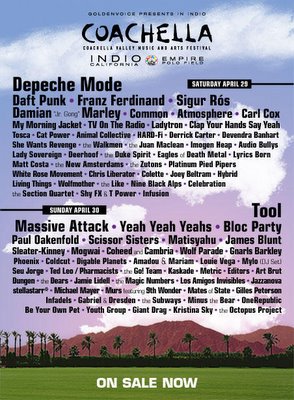
After skipping last year's event, I'll be making my third trip in four years to the Coachella Valley Music Festival. A couple of years ago, we had the Pixies reunion. This year...Tool?!? Suffice it to say the lineup hasn't quite blown me away. Only Massive Attack's belated addition can be described as exciting. Come on, Depeche Mode? As for the rest of the lineup, here's how I'd categorize them:
Stoked. Massive Attack, Digable Planets.
Pleased to see them, but not pumped. Franz Ferdinand, Sleater-Kinney, Bloc Party, Common, YYYs, Sigur Ros, Cat Power, Go! Team, Animal Collective, Ladytron, TV on the Radio, Clap Your Hands, Jazzanova.
Like what I've heard. Wolf Parade, Deerhoof, Phoenix, Magic Numbers, The Like, the Walkmen.
Bleh. Paul Oakenfold, Scissor Sisters, My Morning Jacket (though I do have a burnt copy of It Still Moves), James Blunt, Tool, Ted Leo & the Pharmicists, Depeche Mode (though I do own Catching Up...), Daft Punk (though I do own Discovery).
Bands I've seen before: Mogwai, Metric, The Dears, Atmosphere.
Heard of 'em but never heard em. Devendra Banhart, She Wants Revenge, New Amsterdams, the Editors, Art Brut, Amadou & Mariam.
Who? Everyone else.
UPDATE: The Material Girl herself -- yes, Madonna has been added, and she'll be performing in the intimate venue of the tent, no less. A sell-out is now assured. No word on whom she'll tug along as lesbian stage-show partner. (I previously saw Madonna at the Anaheim Pond back in 2004, the blow-by-blow of which was reported here, probably the only okay thing I've ever posted on music, if my judgment on my own writing can be trusted.)
UPDATE II: After listening fairly extensively to the Coachella player, I'm now looking forward to the following acts:
Art Brut: the kind of overhyped Brit post-punk (neo-punk? retro-punk? whatever...) band you approach with caution, but can't help warming to.
Deerhoof: Okay, they officially rule.
Davendra Banhart: Supposedly a highly experimental, genre-crossing mimic, what I heard on the player was just straight- up blues-influenced folk. But the cognescenti's choice, so definitely will have to check him out.
Giant Drag: The "Kevin is Gay" song on the player is super-catchy shoegaze pop, like warmed-over Breeders. I mean that in a good way.
Jamie Lidell: decent but unremarkable soul revival stuff from what I can tell, but it'll be a good break from wimpdie pop since I ♥ the Otis and Sam Cooke stuff the dude appears to be alluding to.
Lyrics Born: Now I remember: This dude was a key contributor to Blackalicious' quite awesome Blazing Arrow and had an acclaimed album come out a couple years back. Still limited exposure, but good enough for me.
Please drop a comment if you've got some dope some of the more obscure bands in the lineup. Thanks.


Wednesday, February 15, 2006
Tales from the Last Two Weeks of Survival in Bushworld...
10. Darth Cheney shoots a dude in the face, waits 15 hours before going to the Sheriff, another 3 hours before the press learns of the incident from the ranch owner. Cheney then continues to cowardly stonewall the press, per standard operating procedure.
09. Bush's budget is all smoke & mirrors. Like a spendthrift teenager transferring between credit card accounts to hide his reckless spending habits from his parents.
08. Largest public land firesale is proposed by Bush. Why do I have the feeling big developers that contributed mightily to his campaign will be snatching up these public lands at pennies on the dollar?
07. Bush declassifies info to spin the illegal wiretap program. But he never answers the question: how do these terrorists propose to hijack a plane and run it into the Library Tower with a shoebomb? By blowing up their own foot? By blowing up the plane in mid-air? By threatening to blow up the plane? Wtf?
06. Cheney authorized Libby to leak classified info for political purposes; Cheney cherry-picked intelligence to justify war. And french fries are yummy but not so good for you.
05. Bush and co. totally unprepared for Katrina, despite early warnings. It's so bad even House Republicans couldn't whitewash the debacle. In other news, it snowed in Greenland today. And some kool-aid-imbibing morons will continue to insist that we are more secure because these jokers are in charge.
04. Bush's war on science continues: if the experts and research go against Republican dogma, reject the research.
03. Gonzo clowns the Senate Judiciary Committee on illegal wiretaps. Where are the Democrats to press the Bushies on their lawbreaking, especially since new polls show that the American people do not want an imperial presidency? Heeding the idiotic advice of their spineless loser consultants again?
02. The Bush administration in a nutshell: 24-year-old right-wing Bush campaign hack gets a plum PR job with NASA. Proceeds to edit NASA scientists' work to conform to administration propaganda, injects superstition into his memos, and asserts that climate change is simply a figment of the "culture war." Turns out he lied about his college degree on his resume and was forced to resign late last week. Lying hacks over facts.
01. The Continuing National Disgrace that is Guantanamo. Turns out the majority of the prisoners held indefinitely in our torture chambers aren't "enemy combatants" picked up on the battlefield at all, but random people handed by warlords to American troops for a bounty. A useful summary of the National Journal articles here. So we're torturing a bunch of people that we have no evidence of being linked to any terrorist groups. How does this make us more secure again?
UPDATED: This Dahlia Lithwick article summarizing Everything Wrong with Gitmo is so good it has to be linked.
As a reminder: these clowns lead the free world.
Last note: the best blog post of the last two weeks: the morphing of conservatives into Bush cultists. Glenn Greenwald has quickly established himself as one of the most lucid writers in the blogosphere.
Last, last note: let's not forget about the new Abu Ghraib pics that were just released. Ack.
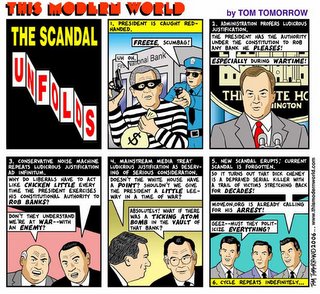
Last, last, last note: always wanted to post a This Modern World cartoon. Check out the archives -- Tom Tomorrow really nails the current state of affairs. We'll see if the above scandals play out according to form.
09. Bush's budget is all smoke & mirrors. Like a spendthrift teenager transferring between credit card accounts to hide his reckless spending habits from his parents.
08. Largest public land firesale is proposed by Bush. Why do I have the feeling big developers that contributed mightily to his campaign will be snatching up these public lands at pennies on the dollar?
07. Bush declassifies info to spin the illegal wiretap program. But he never answers the question: how do these terrorists propose to hijack a plane and run it into the Library Tower with a shoebomb? By blowing up their own foot? By blowing up the plane in mid-air? By threatening to blow up the plane? Wtf?
06. Cheney authorized Libby to leak classified info for political purposes; Cheney cherry-picked intelligence to justify war. And french fries are yummy but not so good for you.
05. Bush and co. totally unprepared for Katrina, despite early warnings. It's so bad even House Republicans couldn't whitewash the debacle. In other news, it snowed in Greenland today. And some kool-aid-imbibing morons will continue to insist that we are more secure because these jokers are in charge.
04. Bush's war on science continues: if the experts and research go against Republican dogma, reject the research.
03. Gonzo clowns the Senate Judiciary Committee on illegal wiretaps. Where are the Democrats to press the Bushies on their lawbreaking, especially since new polls show that the American people do not want an imperial presidency? Heeding the idiotic advice of their spineless loser consultants again?
02. The Bush administration in a nutshell: 24-year-old right-wing Bush campaign hack gets a plum PR job with NASA. Proceeds to edit NASA scientists' work to conform to administration propaganda, injects superstition into his memos, and asserts that climate change is simply a figment of the "culture war." Turns out he lied about his college degree on his resume and was forced to resign late last week. Lying hacks over facts.
01. The Continuing National Disgrace that is Guantanamo. Turns out the majority of the prisoners held indefinitely in our torture chambers aren't "enemy combatants" picked up on the battlefield at all, but random people handed by warlords to American troops for a bounty. A useful summary of the National Journal articles here. So we're torturing a bunch of people that we have no evidence of being linked to any terrorist groups. How does this make us more secure again?
UPDATED: This Dahlia Lithwick article summarizing Everything Wrong with Gitmo is so good it has to be linked.
As a reminder: these clowns lead the free world.
Last note: the best blog post of the last two weeks: the morphing of conservatives into Bush cultists. Glenn Greenwald has quickly established himself as one of the most lucid writers in the blogosphere.
Last, last note: let's not forget about the new Abu Ghraib pics that were just released. Ack.
Last, last, last note: always wanted to post a This Modern World cartoon. Check out the archives -- Tom Tomorrow really nails the current state of affairs. We'll see if the above scandals play out according to form.
Friday, February 03, 2006
Belated Oscar grumblings
Because someone out there must care about this stuff.
(Note: This post is reality-based, meaning you won't see me whining about how the Oscars fucked over Michael Haneke or Mathieu Amalric or Memories of Murder. Well, okay, maybe just a bit about Haneke.)
Snubbery.
1. King Kong -- Peter Jackson for Best Director/Naomi Watts for Best Actress/Best Picture.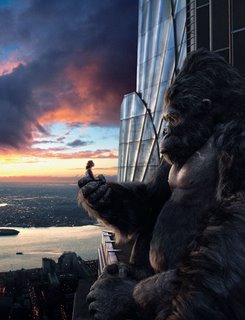
Look, I understand. This little gnome went from being some obscure artgore nerd making flops starring Michael J. Fox to movie wunderkind, a gazillionaire with a shelf full of Oscars. And now, with his extreme makeover, the dude doesn't even look like a comic book shop clerk anymore. Hollywood's got nothing on him. So shutting King Kong out of the major categories might be just a mildly vindictive act of an industry stewing in schaudenfreude. Overstretching? How else to explain King Kong's snubs? Paying homage to classic Hollywood while showing off the latest and greatest in new Hollywood technology, King Kong is Hollywood escapism at its very best: you gasp, you gawk, you laugh, you cry, you sigh, you piss in your pants.
With King Kong and the hobbit trilogy, Jackson has taken a firm hold of the title of Best Big-Budget Filmmaker Working, wresting the crown from the long-dormant James Cameron and the uneven Steven Spielberg. No director can sweep the viewer into such richly detailed fantasy worlds quite like Peter Jackson. Few are as good at exposition and action-staging, and he's galaxies ahead of his peers in weaving CGI-creatures into live action. The key is that, unlike, say, Cameron or Lucas, he's a sensitive director of actors. Yeah, the big ape fights three T-Rexes in one of the most awesome fights ever. But how about those old New York scenes, with a fantasy Times Square that seemed to have emerged from dreams of Juilet Hulme (Kate Winslet in Heavenly Creatures, still Jackson's finest)? Jack Black doing a wicked Orson Welles parody? And how about making an ape-human love story that's convincing, and even moving? Much credit must be given to Naomi Watts, who's forced to make goo-goo eyes at a blue screen. Perhaps she lacked Fay Wray's vampiric sexuality, but this is a classic movie star performance, played opposite a giant computer generated ape, which is deserving of Oscar recognition if only for degree of difficulty.
2. Star Wars Episode III: Revenge of the Sith for Art Direction.
No need to dwell on the movie's big faults -- Lucas' clunky dialogue and (especially) Hayden Christensen, who played one of the medium's most fascinating, tragic characters as little more than an insipid brat. Let's marvel instead at the richly imaginative production design of the Prequels. Remember that planet where Obi-Wan, perched atop a giant alien lizard, hunts down General Greivous, with deep sinkholes and crevices that shoot straight into the planetary core? How about the magma covered rock that hosted the climactic fight? The sinewy trees that cover the Wookie planet? Or even Palpatine's living quarters, with its neo-futurist trappings?
It's true that Mr. Darcy's pad had some nice statutes, but come on. The Academy's production designers are historically biased towards masterpiece theater production design, but nominating Pride over Sith is plain absurd. A joke. An atrocity. An egregious mistake.
(I can't resist a plug for 2046, which features some of most jawdropping production design I've set eyes on. In a perfect world, William Chang would have five Oscars already.)
3. A History of Violence -- David Cronenberg, Best Director/Viggo Mortensen, Best Actor/Maria Bello, Best Supporting Actress.
Like a cinematic Edward Hopper, Cronenberg aims to demythologize the American dream by casting iconographic American motifs in a kind of clinical hyperrealism. I'd be leading the cheers if I didn't find the central idea -- that the American dream is built on the repression of a base ultraviolent instinct but must be defended by that letting loose that same instinct -- so unconvincing. The faults become especially glaring when you set it next to fellow Cannes competitor Caché, another art-thriller-cum-national-allegory about the return of the repressed that is entirely thought through.
However preposterous the story becomes, one can't deny Cronenberg's conceptual daring or rigor in execution, or blame Viggo Mortensen. Tom Stall's duality doesn't stem from schizophrenia but from an exercise of sheer will. Through Viggo's tricky, brilliant performance, we see how Tom's unruffled nobility and Joey's savagery can reside simultaneously in the same person.
As for Ms. Bello, did the voters not remember the animalistic sex scene on the staircase? The conversation with the sheriff and "Joey" in the living room? Bello's conflicted Edie was among the most impressive supporting performance I've seen all year. Predictably, the Academy goes with the gimmick turn by William Hurt.
4. Jeff Daniels (The Squid and the Whale) for Best Supporting Actor.
Yeah. He should be in supporting. I wish I had something to say about this excellent movie and the Daniels' fine performance. But I don't. Sorry.
5. Batman Begins for Best Screenplay/Best Editing.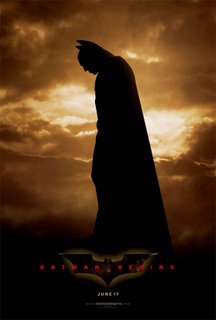
It's not that easy to make a satisfying superhero movie. When it happens, as with Spider-Man 2, the industry should stand up and applaud. Think of the narrative economy of Batman Begins, a tale in which Batman's backstory, his inner demons, a love interest subplot, and a central story involving two villains are seamlessly woven together in a brisk 2 hours and change. Told with ruthless efficiency in a quick, but not frenetic pace, this new Batman origin story, the best Caped Crusader movie I've seen, shows off the director's considerable strengths (few can disseminate story and character information so clearly and efficiently -- no shot is wasted in a Nolan film) while minimizing his weaknesses (weak on atmosphere and mood, and poor usage of location). Nolan deserves his due.
D'oh! (Note: all of the Crash nominations probably belong here, if I could get myself to watch the blasted thing.)
1. Jake Gyllenhaal (Brokeback Mountain) for Best Supporting Actor.
Never cared for the guy, but he surprised me with his sensitive perf as whiny bottom Jack Twist. I loved what Gyllenhaal did in that scene where he shaved very deliberately, his eyes moving just a tad, as he tries to resist ogling Ennis bathing behind him. Donnie Darko started to lose me when he grew that ridiculous painted-on moustache, but the real trouble here is putting Jack in supporting . This make a farce out of the whole lead/supporting distinction. Nearly half the movie is "about" Jack, and the first 3rd of Brokeback is told almost entirely from Jack's point-of-view. Look, you can't blame the studio's campaign strategy, since the supporting category is far less competitive than the male lead this year. They're just trying to get as many Oscar nods as possible. But it doesn't mean that the boneheaded voters should simply get herded around by gay cowboy PR people, following their directives like so much sheep.
2. The annual rant about lameass documentary and foreign film choices.

Dear fogeys, I have sat among you at Academy foreign film screenings, so I harbor no illusions that you can even sit through slow Taiwanese movies, much less vote to nominate one. But there's this movie called Caché that is playing right now, starring Daniel Auteuil (he's the other Frenchie with the big snout, the one from Bon Voyage, Apres Vous, and Manon of the Spring) and Juliette Binoche (you remember her from Chocolat). It is tense. It is dramatic. An elevator ride in which nothing happens can cause the viewer to break out into cold sweat. And it makes far more profound points about the colonial legacy and the causes of terrorism than the Oscar-feted Munich. I realize that this movie might've gotten more attention from you had Haneke cross-cut Binoche orgasming to memories of the October 1961 Algerian massacre in Paris. But notwithstanding the directorial error, this was still a good movie. Also, I thought after nominating both The Fog of War and Capturing the Friedmans two years ago, the documentary committee was finally starting to get it. My mistake.
3. Keira Knightley (Pride & Prejudice) for Best Actress.
Thanks, Academy. Now I'll be forced to hear the trailer voice-over guy intone "Academy Award nominee Keira Knightley" every year for the rest of my life. Sure, if an award were given for the most charming sun-dappled smile, Keira would be a top contender. Alas, this is an award for performance in a lead role. While the not-very-talented Ms. Knightley acquitted herself better than I expected in this superior adaptation of Jane Austen's old chestnut, she, like Winona Ryder, can never quite shake her contemporary mannerisms. Occasionally she comes off distactingly like someone who's itching to text message her buddy shopping at Forever 21. To be fair, most of the time she's serviceable. But when was "serviceable" award-worthy?
4. William Hurt (A History of Violence) for Best Supporting Actor.
No. This movie might've been the masterpiece everyone else thinks it is without the last twenty minutes, of which our yuppie-bad-boy-playing-gangsta was the most prominent distraction.
5. Munich, for Best Picture, Director and Screenplay.
It's hard not to feel a twinge of sympathy for Spielberg and Kushner, assaulted by Zionist zealots on one end and anti-Zionist zealots on the other. Zealots suck. Worse still is the attack from Leon Wieseltier, whose erudition I hold in high esteem. He argues that Munich promotes a "false equivalence" -- except it doesn't. Something can show the costs of aggressive counter-terrorism tactics without condemning the necessity of such tactics, which is what Munich does (though Wieseltier is correct in identifying Spielberg's craven technique of trying to provoke without risking offense). The real problem is Spielberg's heavy-hand, baring down on strong material and turning grim political thrillers, light-hearted romps, and cerebral sci-fi alike into mush. Spielberg, I've come to believe, is our generation's John Ford, another major artist afflicted with an incurable case of the schmaltz. Like Ford, perfection will continue to elude Spielberg's even most accomplished works as long he insists on layering a slice of American cheese over everything he serves up.
Good job, self-congratulatory middlebrow industry bootlickers.
1. Brokeback Mountain. How refreshing that the best American movie of the year will be recognized as such; it's only too bad that Heath Ledger, who towers over the acting field this year, won't share in the glory.
2. Emmanuel Lubezski (The New World) for Best Cinematography. Okay, I'm making plans to catch the shorter cut of this again, just to make sure it's not me but the geeks over on this blog and elsewhere that are insane. But even if Malick's cineaste cause celebre isn't the greatest movie since 2001: A Space Odyssey, it's pretty hard to dispute the claim that this is one of the most ravishingly beautiful films in recent memory, deserving of an all-time Oscar in this category. (Note: 2005 saw a bumper crop of films that, whatever their other flaws, are among the medium's finest ever displays of lighting and composition captured on celluloid. I'm thinking of 2046, The New World, and Three Times. And I bet Claire Denis and Agnes Godard's L'intrus belongs here, too, but I'll have to wait until March to confirm this.)
3. Noah Baumbach (The Squid and the Whale) for Best Original Screenplay.
Sculpting one's childhood trauma into shape is tough enough. To turn your parents' divorce into such a tough, tender, and funny story -- and not letting the squabbling, narcissistic parents off the hook without hanging them -- that's award-worthy. Alright, that wasn't much. But I tried, okay?
4. Catherine Keener (Capote) and Rachel Weisz (The Constant Gardener), for Best Supporting Actress.
They are both great, I imagine. Keener is the most watchable American actress today and was terrific playing against type in The 40-Year-Old Virgin. I've faith that she's doing her usual excellent job in Capote as Harper Lee. And Rachel Weisz. Yum. Though I have some of her finest moments stored in my hard-drive, I can only guess at her flexing her awesome powers in the role an ill-fated do-gooder. Perhaps this weekend I'll find out...
5. George Clooney trifecta; and David Strathairn (Good Night, and Good Luck.) for Best Actor.
If you can be anyone else on earth, who would you choose to be? To me, it's a no-brainer -- the Sultan of Brunei, of course. But if the Sultan were already taken, I might well choose George Clooney, the coolest man around, and perhaps the only movie star in Hollywood worthy of admiration.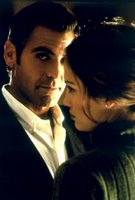 For a guy who has it all, he appears grounded, finds time to smack down Bill O'Reilly, and seems to actually care about the quality of the projects he's involved in. Or maybe he just has a great publicist. Still, in fifty years time, I imagine Clooney's films will still be seen while Brad Pitt and Mel Gibson's titles languish in some mega-server in Kenya. Hollywood's finally given him offical props, and it looks like he'll be taking home a statuette for putting on some pounds. Cool -- though I'd give him a retroactive Oscar to him for Out of Sight instead. But I'm rooting for him here just so I can see an entertaining speech. Excellent helming job, too.
I love those up-angle shots of the neatly dressed Edward R. Murrow, legs crossed in his chair right before going on air, in deep contemplation as a cigarrette dangles from his bony fingers. Clooney's film is about journalistic courage, but what it captures most perceptively is the dynamic of work, how well-meaning, competent people may squabble on the job, but they'll get it done when it counts.
(Note: This post is reality-based, meaning you won't see me whining about how the Oscars fucked over Michael Haneke or Mathieu Amalric or Memories of Murder. Well, okay, maybe just a bit about Haneke.)
Snubbery.
1. King Kong -- Peter Jackson for Best Director/Naomi Watts for Best Actress/Best Picture.

Look, I understand. This little gnome went from being some obscure artgore nerd making flops starring Michael J. Fox to movie wunderkind, a gazillionaire with a shelf full of Oscars. And now, with his extreme makeover, the dude doesn't even look like a comic book shop clerk anymore. Hollywood's got nothing on him. So shutting King Kong out of the major categories might be just a mildly vindictive act of an industry stewing in schaudenfreude. Overstretching? How else to explain King Kong's snubs? Paying homage to classic Hollywood while showing off the latest and greatest in new Hollywood technology, King Kong is Hollywood escapism at its very best: you gasp, you gawk, you laugh, you cry, you sigh, you piss in your pants.
With King Kong and the hobbit trilogy, Jackson has taken a firm hold of the title of Best Big-Budget Filmmaker Working, wresting the crown from the long-dormant James Cameron and the uneven Steven Spielberg. No director can sweep the viewer into such richly detailed fantasy worlds quite like Peter Jackson. Few are as good at exposition and action-staging, and he's galaxies ahead of his peers in weaving CGI-creatures into live action. The key is that, unlike, say, Cameron or Lucas, he's a sensitive director of actors. Yeah, the big ape fights three T-Rexes in one of the most awesome fights ever. But how about those old New York scenes, with a fantasy Times Square that seemed to have emerged from dreams of Juilet Hulme (Kate Winslet in Heavenly Creatures, still Jackson's finest)? Jack Black doing a wicked Orson Welles parody? And how about making an ape-human love story that's convincing, and even moving? Much credit must be given to Naomi Watts, who's forced to make goo-goo eyes at a blue screen. Perhaps she lacked Fay Wray's vampiric sexuality, but this is a classic movie star performance, played opposite a giant computer generated ape, which is deserving of Oscar recognition if only for degree of difficulty.
2. Star Wars Episode III: Revenge of the Sith for Art Direction.
No need to dwell on the movie's big faults -- Lucas' clunky dialogue and (especially) Hayden Christensen, who played one of the medium's most fascinating, tragic characters as little more than an insipid brat. Let's marvel instead at the richly imaginative production design of the Prequels. Remember that planet where Obi-Wan, perched atop a giant alien lizard, hunts down General Greivous, with deep sinkholes and crevices that shoot straight into the planetary core? How about the magma covered rock that hosted the climactic fight? The sinewy trees that cover the Wookie planet? Or even Palpatine's living quarters, with its neo-futurist trappings?
It's true that Mr. Darcy's pad had some nice statutes, but come on. The Academy's production designers are historically biased towards masterpiece theater production design, but nominating Pride over Sith is plain absurd. A joke. An atrocity. An egregious mistake.
(I can't resist a plug for 2046, which features some of most jawdropping production design I've set eyes on. In a perfect world, William Chang would have five Oscars already.)
3. A History of Violence -- David Cronenberg, Best Director/Viggo Mortensen, Best Actor/Maria Bello, Best Supporting Actress.
Like a cinematic Edward Hopper, Cronenberg aims to demythologize the American dream by casting iconographic American motifs in a kind of clinical hyperrealism. I'd be leading the cheers if I didn't find the central idea -- that the American dream is built on the repression of a base ultraviolent instinct but must be defended by that letting loose that same instinct -- so unconvincing. The faults become especially glaring when you set it next to fellow Cannes competitor Caché, another art-thriller-cum-national-allegory about the return of the repressed that is entirely thought through.
However preposterous the story becomes, one can't deny Cronenberg's conceptual daring or rigor in execution, or blame Viggo Mortensen. Tom Stall's duality doesn't stem from schizophrenia but from an exercise of sheer will. Through Viggo's tricky, brilliant performance, we see how Tom's unruffled nobility and Joey's savagery can reside simultaneously in the same person.
As for Ms. Bello, did the voters not remember the animalistic sex scene on the staircase? The conversation with the sheriff and "Joey" in the living room? Bello's conflicted Edie was among the most impressive supporting performance I've seen all year. Predictably, the Academy goes with the gimmick turn by William Hurt.
4. Jeff Daniels (The Squid and the Whale) for Best Supporting Actor.
Yeah. He should be in supporting. I wish I had something to say about this excellent movie and the Daniels' fine performance. But I don't. Sorry.
5. Batman Begins for Best Screenplay/Best Editing.

It's not that easy to make a satisfying superhero movie. When it happens, as with Spider-Man 2, the industry should stand up and applaud. Think of the narrative economy of Batman Begins, a tale in which Batman's backstory, his inner demons, a love interest subplot, and a central story involving two villains are seamlessly woven together in a brisk 2 hours and change. Told with ruthless efficiency in a quick, but not frenetic pace, this new Batman origin story, the best Caped Crusader movie I've seen, shows off the director's considerable strengths (few can disseminate story and character information so clearly and efficiently -- no shot is wasted in a Nolan film) while minimizing his weaknesses (weak on atmosphere and mood, and poor usage of location). Nolan deserves his due.
D'oh! (Note: all of the Crash nominations probably belong here, if I could get myself to watch the blasted thing.)
1. Jake Gyllenhaal (Brokeback Mountain) for Best Supporting Actor.
Never cared for the guy, but he surprised me with his sensitive perf as whiny bottom Jack Twist. I loved what Gyllenhaal did in that scene where he shaved very deliberately, his eyes moving just a tad, as he tries to resist ogling Ennis bathing behind him. Donnie Darko started to lose me when he grew that ridiculous painted-on moustache, but the real trouble here is putting Jack in supporting . This make a farce out of the whole lead/supporting distinction. Nearly half the movie is "about" Jack, and the first 3rd of Brokeback is told almost entirely from Jack's point-of-view. Look, you can't blame the studio's campaign strategy, since the supporting category is far less competitive than the male lead this year. They're just trying to get as many Oscar nods as possible. But it doesn't mean that the boneheaded voters should simply get herded around by gay cowboy PR people, following their directives like so much sheep.
2. The annual rant about lameass documentary and foreign film choices.

Dear fogeys, I have sat among you at Academy foreign film screenings, so I harbor no illusions that you can even sit through slow Taiwanese movies, much less vote to nominate one. But there's this movie called Caché that is playing right now, starring Daniel Auteuil (he's the other Frenchie with the big snout, the one from Bon Voyage, Apres Vous, and Manon of the Spring) and Juliette Binoche (you remember her from Chocolat). It is tense. It is dramatic. An elevator ride in which nothing happens can cause the viewer to break out into cold sweat. And it makes far more profound points about the colonial legacy and the causes of terrorism than the Oscar-feted Munich. I realize that this movie might've gotten more attention from you had Haneke cross-cut Binoche orgasming to memories of the October 1961 Algerian massacre in Paris. But notwithstanding the directorial error, this was still a good movie. Also, I thought after nominating both The Fog of War and Capturing the Friedmans two years ago, the documentary committee was finally starting to get it. My mistake.
3. Keira Knightley (Pride & Prejudice) for Best Actress.
Thanks, Academy. Now I'll be forced to hear the trailer voice-over guy intone "Academy Award nominee Keira Knightley" every year for the rest of my life. Sure, if an award were given for the most charming sun-dappled smile, Keira would be a top contender. Alas, this is an award for performance in a lead role. While the not-very-talented Ms. Knightley acquitted herself better than I expected in this superior adaptation of Jane Austen's old chestnut, she, like Winona Ryder, can never quite shake her contemporary mannerisms. Occasionally she comes off distactingly like someone who's itching to text message her buddy shopping at Forever 21. To be fair, most of the time she's serviceable. But when was "serviceable" award-worthy?
4. William Hurt (A History of Violence) for Best Supporting Actor.
No. This movie might've been the masterpiece everyone else thinks it is without the last twenty minutes, of which our yuppie-bad-boy-playing-gangsta was the most prominent distraction.
5. Munich, for Best Picture, Director and Screenplay.
It's hard not to feel a twinge of sympathy for Spielberg and Kushner, assaulted by Zionist zealots on one end and anti-Zionist zealots on the other. Zealots suck. Worse still is the attack from Leon Wieseltier, whose erudition I hold in high esteem. He argues that Munich promotes a "false equivalence" -- except it doesn't. Something can show the costs of aggressive counter-terrorism tactics without condemning the necessity of such tactics, which is what Munich does (though Wieseltier is correct in identifying Spielberg's craven technique of trying to provoke without risking offense). The real problem is Spielberg's heavy-hand, baring down on strong material and turning grim political thrillers, light-hearted romps, and cerebral sci-fi alike into mush. Spielberg, I've come to believe, is our generation's John Ford, another major artist afflicted with an incurable case of the schmaltz. Like Ford, perfection will continue to elude Spielberg's even most accomplished works as long he insists on layering a slice of American cheese over everything he serves up.
Good job, self-congratulatory middlebrow industry bootlickers.
1. Brokeback Mountain. How refreshing that the best American movie of the year will be recognized as such; it's only too bad that Heath Ledger, who towers over the acting field this year, won't share in the glory.
2. Emmanuel Lubezski (The New World) for Best Cinematography. Okay, I'm making plans to catch the shorter cut of this again, just to make sure it's not me but the geeks over on this blog and elsewhere that are insane. But even if Malick's cineaste cause celebre isn't the greatest movie since 2001: A Space Odyssey, it's pretty hard to dispute the claim that this is one of the most ravishingly beautiful films in recent memory, deserving of an all-time Oscar in this category. (Note: 2005 saw a bumper crop of films that, whatever their other flaws, are among the medium's finest ever displays of lighting and composition captured on celluloid. I'm thinking of 2046, The New World, and Three Times. And I bet Claire Denis and Agnes Godard's L'intrus belongs here, too, but I'll have to wait until March to confirm this.)
3. Noah Baumbach (The Squid and the Whale) for Best Original Screenplay.
Sculpting one's childhood trauma into shape is tough enough. To turn your parents' divorce into such a tough, tender, and funny story -- and not letting the squabbling, narcissistic parents off the hook without hanging them -- that's award-worthy. Alright, that wasn't much. But I tried, okay?
4. Catherine Keener (Capote) and Rachel Weisz (The Constant Gardener), for Best Supporting Actress.

They are both great, I imagine. Keener is the most watchable American actress today and was terrific playing against type in The 40-Year-Old Virgin. I've faith that she's doing her usual excellent job in Capote as Harper Lee. And Rachel Weisz. Yum. Though I have some of her finest moments stored in my hard-drive, I can only guess at her flexing her awesome powers in the role an ill-fated do-gooder. Perhaps this weekend I'll find out...
5. George Clooney trifecta; and David Strathairn (Good Night, and Good Luck.) for Best Actor.
If you can be anyone else on earth, who would you choose to be? To me, it's a no-brainer -- the Sultan of Brunei, of course. But if the Sultan were already taken, I might well choose George Clooney, the coolest man around, and perhaps the only movie star in Hollywood worthy of admiration.
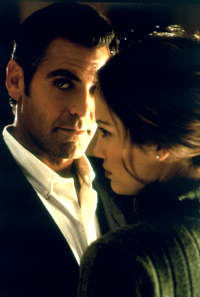 For a guy who has it all, he appears grounded, finds time to smack down Bill O'Reilly, and seems to actually care about the quality of the projects he's involved in. Or maybe he just has a great publicist. Still, in fifty years time, I imagine Clooney's films will still be seen while Brad Pitt and Mel Gibson's titles languish in some mega-server in Kenya. Hollywood's finally given him offical props, and it looks like he'll be taking home a statuette for putting on some pounds. Cool -- though I'd give him a retroactive Oscar to him for Out of Sight instead. But I'm rooting for him here just so I can see an entertaining speech. Excellent helming job, too.
I love those up-angle shots of the neatly dressed Edward R. Murrow, legs crossed in his chair right before going on air, in deep contemplation as a cigarrette dangles from his bony fingers. Clooney's film is about journalistic courage, but what it captures most perceptively is the dynamic of work, how well-meaning, competent people may squabble on the job, but they'll get it done when it counts.
Tuesday, January 31, 2006
A return trip to Brokeback
Given all the bloggable items and events out there, a post defending Brokeback Mountain might strike you as being about as necessary someone pronouncing Lebron James to be a good basketball player. But even if a second-round of backlash after the morning's Oscar nomination annoucement doesn't materialize, but I think certain aspects of Brokeback remain underappreciated (especially the story/screenplay). So herewith are two narrative choices I found especially compelling. (This will hold you over until my next post: Why Shakespeare is a good playwright.)
SPOILERS ahoy.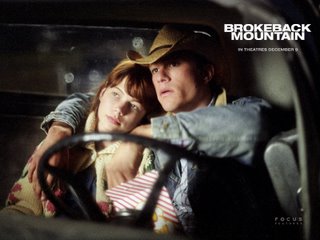
(A) Alma catches a glimpse of a passionate reunion.
Soon after Ennis and Jack part ways after that lustful summer at Brokeback, Ennis quickly adjusts to life with fiance Alma. In an economical five minutes, Lee sets up a life of low-rent domestic bliss for the newlywed Del Mars -- a bliss interrupted by a postcard from Jack "Nasty" Twist. Anyone who's watched his share of what I call Love Imprisoned movies will think he know what's coming next. In such masterpieces of the genre as The Age of Innocence and Far From Heaven, the reintroduction of the verboten love interest is when the stakes are raised and the central dramatic tension comes into focus: In seeing Madame Olenska again, Newland Archer reflects on the mundane future he's set to lead with the pretty and completely conventional May Welland. When Cathy bumps into Raymond at the museum, the contrast between Raymond's thoughtfulness and the capricious pettiness of Cathy's clique is established. In those tragedies of manners, love and passion are a means of liberation from a suffocating, small-minded (yet safe and comfortable) pocket of existence. These are in a sense prison-break movies, with the spouse (or spouse-to-be) in the role of the prison warden.
Brokeback, which ultimately fits the Love Imprisoned template to a T, sets up the situation perfectly. We expect that when Ennis meets Jack again, he'll hee and haw a bit about leading a different life now, do a little cockteasing until Jack finally pins him down and reignite their passion. Alma will turn either into an insufferable nag or a needy victim but will remain completely in the dark about the true nature of Ennis and Jack's fishing expeditions until maybe the middle of the third act. The rules governing these movies dictate this kind of narrative progression.
So what actually happens? Jack and Ennis immediately fall into each other's arms (which really surprised me), but even more shocking to me was that Alma catches a glimpse of this little tryst right off the bat. Not only is this completely unexpected, Alma's knowledge of what's going on, which Lee didn't linger on, completely recalibrates the film. Instead of being merely the warden (which she still kind of was), Alma herself becomes a tragic figure. She's aware of what's going on, but suffers silently in hopes that Ennis' homoerotic passions will temper. For a brief time, the film adopts Alma's perspective as the increasingly inattentive Ennis bailed on her and their daughter for long trips with Jack. And Michelle Williams, toeing that fine line between knowing resignation and incomprehending cuckolded spouse, keeps Alma sympathetic without quite reducing her to being a mere victim of a callous husband.
Even though Love Imprisoned movies take as a subject love's powerlessness -- eros' impotence in penetrating the walls of social convention -- the truly great ones are careful not to demonize society. I imagine it's easy to give in to the temptation to turn Brokeback into a tract about how an imcomprehending, homophobic West of the 1960s can keep lovers apart. But the excellent (and underappreciated) screenplay avoids this kind of easy choice at every turn, with this Alma thread being among the most inspired. In other movies, the Alma's suffering would be treated as little more than collateral damage; here, we're shown the pain not only of the thwarted lovers, but the suffering of the "dead weight" spouses left behind.
[Second SPOILER warning -- btw, King Kong dies and the Titanic sinks.]
(B) Ennis receives word of Jack's fate from Lureen
Recall how Ennis finds out about Jack. After his mail to to his "fishing buddy" gets returned with a disturbing stamp, Ennis calls Jack's place. Lureen picks up and proceeds to tell Ennis about Jack's "accident" -- something about a tire iron hitting his face. As Ennis listens, he begins to imagine what might have really happened. We see a gruesome Matthew Shepard-type hate crime unfold. But is that what happened? Lee made sure to keep it ambiguous. The hate crime was cross-cut with Ennis' anguished visage, which makes clear that this scenario emerged from Ennis' head. And earlier, Ennis told Jack about the time his dad taking him to see the mutilated corpse of a murdered gay man. That formative image impressed itself in Ennis' psyche, which, coupled with his more conservative, unambitious temperament and his attachment to his daughter, explains Ennis' reluctance to even entertain Jack's escape to Eden pitches.
So the hate crime scenario may well exist only in the fevered imagination of a distraught and paranoid Ennis. But Anne Hathaway's clipped, suspiciously tart delivery of the news to Ennis makes one wonder. And Lureen is clearly withholding something in that conversation, but it's not clear exactly what it is. Does she know about Ennis and Jack? If so, how? The most likely explanation is that Lureen found out about Jack's homosexuality only because he was killed by a bunch of murderous homophobes. She put the two and two together and realized that Ennis the fishing buddy was his lover.
This explanation is bolstered by Ennis' trip to the Twist farm. There, Ennis meets Jack's parents, and engages in awkward conversation filled with pregnant pauses and punctuated by the father's barely concealed hostility. The two scenes here were especially good, as the parties grieve together even while Ennis and the viewer wonder whether the parents know. If the father seems a little too vocal about keeping Jack's remains on the farm (rather than sprinkled over Brokeback), it's still not entirely clear that his insistence on burial grounds isn't borne out of crusty traditionalism rather than any knowing resistance to Jack's lifestyle.
In the end, we don't know what happened to Jack. But it doesn't really matter. Not knowing makes the movie better. In these last scenes, charged with a bracing ambiguity, Brokeback Mountain undercuts the sentimentality and political positioning intrinsic to the scenario -- it's finally less a searing indictment of an intolerant society as it is a subdued, but deeply moving tale of Love Imprisoned.
SPOILERS ahoy.

(A) Alma catches a glimpse of a passionate reunion.
Soon after Ennis and Jack part ways after that lustful summer at Brokeback, Ennis quickly adjusts to life with fiance Alma. In an economical five minutes, Lee sets up a life of low-rent domestic bliss for the newlywed Del Mars -- a bliss interrupted by a postcard from Jack "Nasty" Twist. Anyone who's watched his share of what I call Love Imprisoned movies will think he know what's coming next. In such masterpieces of the genre as The Age of Innocence and Far From Heaven, the reintroduction of the verboten love interest is when the stakes are raised and the central dramatic tension comes into focus: In seeing Madame Olenska again, Newland Archer reflects on the mundane future he's set to lead with the pretty and completely conventional May Welland. When Cathy bumps into Raymond at the museum, the contrast between Raymond's thoughtfulness and the capricious pettiness of Cathy's clique is established. In those tragedies of manners, love and passion are a means of liberation from a suffocating, small-minded (yet safe and comfortable) pocket of existence. These are in a sense prison-break movies, with the spouse (or spouse-to-be) in the role of the prison warden.
Brokeback, which ultimately fits the Love Imprisoned template to a T, sets up the situation perfectly. We expect that when Ennis meets Jack again, he'll hee and haw a bit about leading a different life now, do a little cockteasing until Jack finally pins him down and reignite their passion. Alma will turn either into an insufferable nag or a needy victim but will remain completely in the dark about the true nature of Ennis and Jack's fishing expeditions until maybe the middle of the third act. The rules governing these movies dictate this kind of narrative progression.
So what actually happens? Jack and Ennis immediately fall into each other's arms (which really surprised me), but even more shocking to me was that Alma catches a glimpse of this little tryst right off the bat. Not only is this completely unexpected, Alma's knowledge of what's going on, which Lee didn't linger on, completely recalibrates the film. Instead of being merely the warden (which she still kind of was), Alma herself becomes a tragic figure. She's aware of what's going on, but suffers silently in hopes that Ennis' homoerotic passions will temper. For a brief time, the film adopts Alma's perspective as the increasingly inattentive Ennis bailed on her and their daughter for long trips with Jack. And Michelle Williams, toeing that fine line between knowing resignation and incomprehending cuckolded spouse, keeps Alma sympathetic without quite reducing her to being a mere victim of a callous husband.
Even though Love Imprisoned movies take as a subject love's powerlessness -- eros' impotence in penetrating the walls of social convention -- the truly great ones are careful not to demonize society. I imagine it's easy to give in to the temptation to turn Brokeback into a tract about how an imcomprehending, homophobic West of the 1960s can keep lovers apart. But the excellent (and underappreciated) screenplay avoids this kind of easy choice at every turn, with this Alma thread being among the most inspired. In other movies, the Alma's suffering would be treated as little more than collateral damage; here, we're shown the pain not only of the thwarted lovers, but the suffering of the "dead weight" spouses left behind.
[Second SPOILER warning -- btw, King Kong dies and the Titanic sinks.]
(B) Ennis receives word of Jack's fate from Lureen
Recall how Ennis finds out about Jack. After his mail to to his "fishing buddy" gets returned with a disturbing stamp, Ennis calls Jack's place. Lureen picks up and proceeds to tell Ennis about Jack's "accident" -- something about a tire iron hitting his face. As Ennis listens, he begins to imagine what might have really happened. We see a gruesome Matthew Shepard-type hate crime unfold. But is that what happened? Lee made sure to keep it ambiguous. The hate crime was cross-cut with Ennis' anguished visage, which makes clear that this scenario emerged from Ennis' head. And earlier, Ennis told Jack about the time his dad taking him to see the mutilated corpse of a murdered gay man. That formative image impressed itself in Ennis' psyche, which, coupled with his more conservative, unambitious temperament and his attachment to his daughter, explains Ennis' reluctance to even entertain Jack's escape to Eden pitches.

So the hate crime scenario may well exist only in the fevered imagination of a distraught and paranoid Ennis. But Anne Hathaway's clipped, suspiciously tart delivery of the news to Ennis makes one wonder. And Lureen is clearly withholding something in that conversation, but it's not clear exactly what it is. Does she know about Ennis and Jack? If so, how? The most likely explanation is that Lureen found out about Jack's homosexuality only because he was killed by a bunch of murderous homophobes. She put the two and two together and realized that Ennis the fishing buddy was his lover.
This explanation is bolstered by Ennis' trip to the Twist farm. There, Ennis meets Jack's parents, and engages in awkward conversation filled with pregnant pauses and punctuated by the father's barely concealed hostility. The two scenes here were especially good, as the parties grieve together even while Ennis and the viewer wonder whether the parents know. If the father seems a little too vocal about keeping Jack's remains on the farm (rather than sprinkled over Brokeback), it's still not entirely clear that his insistence on burial grounds isn't borne out of crusty traditionalism rather than any knowing resistance to Jack's lifestyle.
In the end, we don't know what happened to Jack. But it doesn't really matter. Not knowing makes the movie better. In these last scenes, charged with a bracing ambiguity, Brokeback Mountain undercuts the sentimentality and political positioning intrinsic to the scenario -- it's finally less a searing indictment of an intolerant society as it is a subdued, but deeply moving tale of Love Imprisoned.
Thursday, January 26, 2006
Dear Girlfriend,
In a post 9/11 world besieged by tsunamis, hurricanes, suicidal fanatics, and incompetent wingnuts, you have chosen to devote your energies to lamenting my lack of sartorial polish. I won't begrudge your priorities, but let me clue you in on something: I did wear matching socks today. Not right now, as I'm typing while lying in bed, barefoot. But earlier today, a set of blue argyle socks adorned my feet. I also fit my belt into all five loops on my slacks. And, believe it or not, I didn't forget my keysphonewallet when I left for work. I even remembered my lip balm.
It may shock you to learn that I wear matching socks approximately 87.6% of the time.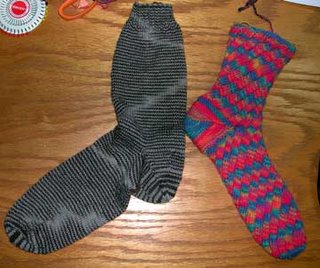 That's about 8 out of every 9 days -- pretty good in my book. To put it in perspective, Kobe Bryant is more likely to miss a free throw than the chance of you catching me donning mispaired socks. And who cares, really? If, by chance, my left foot had on a dark grey sock with 2 mm horizontal grooves while my right had on a dark grey sock with black vertical pinlines, who will look closely enough to tell? Besides you, that is? Heck, if somebody's wearing a black sock and blue sock, I probably can't tell. I mean, does anyone look at other people's socks? I personally prefer to ponder the dangers of Iran's nuclear capabilities in my idle time.
As for belt loops, isn't the function of a belt to make sure your pants doesn't fall off? By that measure, I'm doing fine; I haven't accidently dropped trou since maybe fourth grade. So a loop gets missed once in while. Maybe even 23% of the time. But that means 77% of the time, I've secured my belt perfectly. 77%! Shouldn't that count for something? That leads to keysphonewallet. By my calculations, a good 68.2% of the time, I will be entirely successful in leaving the house with those indispensable items. To better understand that percentage, just consider that Matt Leinart is less likely to complete a pass than I am to flub the simple task of taking the keyphonewallet with me. Please note that Leinart won the Heisman Trophy two years ago. Admittedly, on a few occasions, I have inconvenienced myself and others because I had to return home to retrieve said items. But did anyone suffer permanent scarring as a result of my absent-mindedness? Did anyone lose a limb? Let's keep things in perspective here.
Instead of haranguing me about cotton stockings, we could be enjoying delightful, illuminating conversations about David Foster Wallace's essay on porn awards, the mythology behind Chinese spring rolls, Martina Hingis' comeback, the recent Canadian elections, the MacBook vs. PowerBook, Scalito's confirmation hearings, or any of the endlessly fascinating subjects that I follow daily.
You know what I think the problem is? Unrealistic expectations, a scourge of relationships. Come to think of it, high expectations might be the central culprit behind human misery. Nobody gets props for getting things right. They just get blamed when shit goes down. Wouldn't the world be much better off if people got plaudits for getting things right? Recall the central lesson imparted by Steven Levitt, author of your beloved Freakonomics: the power of incentives to affect behavior. Imagine a world where the DMV awards you money for stopping at a red light, instead of you getting fined for running a light. Instead of blithely ignoring the cashier who gives you back the correct change, one should express appreciation for competence and a job well-done. What's the harm of saying, "thank you so much for your accurate sorting of the $2.37 in two one-dollar denominations, a quarter, a dime and two pennies, owed to me. Great job!"? Statements like that will not only cheer up the cashier, it may encourage continued excellent cashiering. And you know about the big media flare-up this month, when activists blogrushed Washington Post's ombudsman Deborah Howell for her misstatements concerning the Republican Abramoff scandal? Wrong approach, I say. How about adding a comment commending Howell for her perfect spelling? How's that for "civility." And why not give plaudits to chefs who don't serve burnt pasta? If you temper your expectations, you might enjoy your meal, rather than nitpick pasta texture. Wait, that's what I do. But you get the picture.
All I'm saying is a different approach, one that takes into account advanced microeconomic theory and the latest research on behaviorial psychology, might serve you better. "Hey, good job not missing any belt loops, bud" might be more effective than "ai-ya, what am I gonna do with such a hapless boyfriend! I wish I could quit you!" Give it some thought.
Yours sincerely,
The Boyfriend.
It may shock you to learn that I wear matching socks approximately 87.6% of the time.
 That's about 8 out of every 9 days -- pretty good in my book. To put it in perspective, Kobe Bryant is more likely to miss a free throw than the chance of you catching me donning mispaired socks. And who cares, really? If, by chance, my left foot had on a dark grey sock with 2 mm horizontal grooves while my right had on a dark grey sock with black vertical pinlines, who will look closely enough to tell? Besides you, that is? Heck, if somebody's wearing a black sock and blue sock, I probably can't tell. I mean, does anyone look at other people's socks? I personally prefer to ponder the dangers of Iran's nuclear capabilities in my idle time.
As for belt loops, isn't the function of a belt to make sure your pants doesn't fall off? By that measure, I'm doing fine; I haven't accidently dropped trou since maybe fourth grade. So a loop gets missed once in while. Maybe even 23% of the time. But that means 77% of the time, I've secured my belt perfectly. 77%! Shouldn't that count for something? That leads to keysphonewallet. By my calculations, a good 68.2% of the time, I will be entirely successful in leaving the house with those indispensable items. To better understand that percentage, just consider that Matt Leinart is less likely to complete a pass than I am to flub the simple task of taking the keyphonewallet with me. Please note that Leinart won the Heisman Trophy two years ago. Admittedly, on a few occasions, I have inconvenienced myself and others because I had to return home to retrieve said items. But did anyone suffer permanent scarring as a result of my absent-mindedness? Did anyone lose a limb? Let's keep things in perspective here.
Instead of haranguing me about cotton stockings, we could be enjoying delightful, illuminating conversations about David Foster Wallace's essay on porn awards, the mythology behind Chinese spring rolls, Martina Hingis' comeback, the recent Canadian elections, the MacBook vs. PowerBook, Scalito's confirmation hearings, or any of the endlessly fascinating subjects that I follow daily.
You know what I think the problem is? Unrealistic expectations, a scourge of relationships. Come to think of it, high expectations might be the central culprit behind human misery. Nobody gets props for getting things right. They just get blamed when shit goes down. Wouldn't the world be much better off if people got plaudits for getting things right? Recall the central lesson imparted by Steven Levitt, author of your beloved Freakonomics: the power of incentives to affect behavior. Imagine a world where the DMV awards you money for stopping at a red light, instead of you getting fined for running a light. Instead of blithely ignoring the cashier who gives you back the correct change, one should express appreciation for competence and a job well-done. What's the harm of saying, "thank you so much for your accurate sorting of the $2.37 in two one-dollar denominations, a quarter, a dime and two pennies, owed to me. Great job!"? Statements like that will not only cheer up the cashier, it may encourage continued excellent cashiering. And you know about the big media flare-up this month, when activists blogrushed Washington Post's ombudsman Deborah Howell for her misstatements concerning the Republican Abramoff scandal? Wrong approach, I say. How about adding a comment commending Howell for her perfect spelling? How's that for "civility." And why not give plaudits to chefs who don't serve burnt pasta? If you temper your expectations, you might enjoy your meal, rather than nitpick pasta texture. Wait, that's what I do. But you get the picture.
All I'm saying is a different approach, one that takes into account advanced microeconomic theory and the latest research on behaviorial psychology, might serve you better. "Hey, good job not missing any belt loops, bud" might be more effective than "ai-ya, what am I gonna do with such a hapless boyfriend! I wish I could quit you!" Give it some thought.
Yours sincerely,
The Boyfriend.
Thursday, January 12, 2006
Stalkers of the world unite
Did you know that your cellphone records can be bought by anybody for $110? Neither did I, until a couple of days ago. Apparently it's real. A popular blogger tested it out and was able to get ahold of 2004 presidential candidate Wesley Clark's phone records for about $90.
This is the latest (and to my mind, most frightening) development in the ongoing erosion of the private sphere. In the background, largely invisible sentries track our every move. Cookies log our websurfing habits. Supermarket discount cards register our grocery purchase patterns. Credit card companies monitor usage (and will alert you if your spending pattern becomes "irregular"). The government may be eavesdropping on your phone conversation. Employers can look over your e-mail. Huge consumer-info databases sell all of this information to unknown third parties.
In order to keep sane, one has to accept much of this as a hassle of modern living. This one's different. It affects all of us. Reporters receiving anonymous tips from whistleblowers might stop getting them. Public figures may now see their phone records as grist for the US Weekly mill. Anybody involved in troubled marriages, business partnerships, etc. may now find it irresistible to try get the dope on a partner to try to confirm their suspicions.
You've been harboring that crush on that fetching co-worker six cubicles down? Curious about her private life? Now you can pay $110 and retrieve her cell phone records! Wondering what your ex-boyfriend is up to these days? $110 dollars.
It's one thing to cyberstalk someone on Friendster or his/her blog. The subject being stalked there is availing himself in a public forum. This is something else entirely. Cell phone records have an expectation of privacy. As a private citizen, you're only supposed to be able to get your hands on another private citizen's cell phone records if you're involved in litigation where this information is highly relevant. There's a procedure for that -- a subpoena issued by the court. Now you can bypass the pesky requirements of legal procedure for a nominal fee.
This is the democratization of Big Brother. Now anyone can be watching you. If he or she is willing to shell out a hundred bucks.
This is the latest (and to my mind, most frightening) development in the ongoing erosion of the private sphere. In the background, largely invisible sentries track our every move. Cookies log our websurfing habits. Supermarket discount cards register our grocery purchase patterns. Credit card companies monitor usage (and will alert you if your spending pattern becomes "irregular"). The government may be eavesdropping on your phone conversation. Employers can look over your e-mail. Huge consumer-info databases sell all of this information to unknown third parties.
In order to keep sane, one has to accept much of this as a hassle of modern living. This one's different. It affects all of us. Reporters receiving anonymous tips from whistleblowers might stop getting them. Public figures may now see their phone records as grist for the US Weekly mill. Anybody involved in troubled marriages, business partnerships, etc. may now find it irresistible to try get the dope on a partner to try to confirm their suspicions.
You've been harboring that crush on that fetching co-worker six cubicles down? Curious about her private life? Now you can pay $110 and retrieve her cell phone records! Wondering what your ex-boyfriend is up to these days? $110 dollars.
It's one thing to cyberstalk someone on Friendster or his/her blog. The subject being stalked there is availing himself in a public forum. This is something else entirely. Cell phone records have an expectation of privacy. As a private citizen, you're only supposed to be able to get your hands on another private citizen's cell phone records if you're involved in litigation where this information is highly relevant. There's a procedure for that -- a subpoena issued by the court. Now you can bypass the pesky requirements of legal procedure for a nominal fee.
This is the democratization of Big Brother. Now anyone can be watching you. If he or she is willing to shell out a hundred bucks.
Subscribe to:
Posts (Atom)