Tuesday, March 08, 2005

Kettle Dill & Sour Cream Chips

My favorite junk snack growing up was the Laura Scudder's Sour Cream & Onion Potato Chips, which came in twin pack bags pumped with enough air to fill a tire. In 1987 or thereabouts, these chips were discontinued, and I've never really gotten over it, at least until two years ago. That's when Kettle Chips, my favorite brand of chips, came out with their Krinkle Cut Dill & Sour Cream Chips. Naturally I sampled a bag, and wouldn't you know that they appeared to have reverse-engineered the Laura Scudder's formula, and improved on it by making the chips less oily, more crunchy, and more evenly salted.

These chips were plain awesome. I quickly became addicted. I must've eaten like two bags a week for a few months in 2004. But as with all junk foods, you eventually get tired of gorging on them. So I laid off until recently, when I visited a couple of different Trader Joe's looking for these chips. But they didn't have it! Did they discontinue this line, repeating one of the signature traumatic moments of my youth?!? Do they think that this time it can be played for farce?!? Did the sales plunge to unacceptable levels after my own habit got kicked?

I don't know, but I've been very upset about this. As with everything, I blame those wacko Lars von Trier-worshippers, who no doubt snack on the inferior sour cream & onion chips made by Ruffles, thereby distorting the sc&o chip market with their skewed purchasing habits. Oh, if you confront them they'll give you a good spiel about the higher levels of maltodextrin in Ruffles or something creating "greater artificiality and abstraction of flavor." But it's all b.s. The real reason is because hell wants both LvT and Ruffles while heaven won't take either of them. So Earth is stuck with them both. Ugh!

Thursday, March 03, 2005

Query

1. Have you ever uttered the word "bravura" casually in conversation?

2. If so, did you feel like a pompous ass immediately afterwards? Like an NPR art reviewer, perhaps?

3. Have you ever stopped yourself from saying "bravura" even though you had a phrase right on the tip of your tongue like "bravura guitar solo" or "bravura tracking shot"?

Thank you for your time and patience. For your troubles, you will receive 500 frequent flyer miles on Pan Am Airways. Pan Am, the Only Way to Fly.

Wednesday, March 02, 2005

From the Sontag Selects series

The late Susan Sontag, like all astute intellectuals, adored classic Japanese cinema. She programmed two series of classic Japanese movies in the last two years, the second of which has arrived in Los Angeles. A few capsules:

Pigs and Battleships (Imamura, 1961) B+/B

Before Bruno Dumont put homo sapiens up in cages and primed the species for dissection, cinema's foremost zoologist was (and is, I suppose) Shohei Imamura. This awesomely titled picture, one of Imamura's earliest films, is very typical of his (considerably more limited) 60s stuff. In stunning b & w scope, Imamura shows humanity at its most base. It's life lived in the "lower orders" -- peasants who live by instinct and are concerned only with eating, sex, and idleness, preferably in the most vulgar ways -- in diametric opposition to his sensei Ozu's focus on middle class society and its manners. Pigs works in an extended metaphor between the gangsters who run a hog operation and the pig themselves, making the point that parasitic Japanese lives are no better than pigs in a pen. Exceptionally pungent, and filled with astonishing scenes, especially that climax with pigs overrunning the town, if not altogether coherent (Imamura's never been a good storyteller) -- the best part of the movie is the setting. Set in a Japanese town catering to an American naval base in Japan, Imamura views the Japanese there as leeches, either whores selling themselves out to Americans or, worse, two-bit hoods who are good for nothing except squeezing Japanese parasites for some dough -- the bloodsuckers of mosquitos. This movie is ultimately about that most compelling of themes: the community as prison, from which one must escape or die.

Repast
(Naruse, 1951)A-

If all you've seen from Ozu are Tokyo Story, Late Spring, and
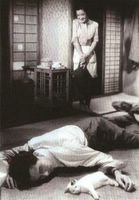
An Autumn Afternoon, from Mizoguchi only Ugetsu, Sansho the Bailiff, and Story of the Last Chrysanthemum, and from Kurosawa only High and Low, Yojimbo and Seven Samurai, you'd have this impression that each is an unassailable master of the art. A more complete survey will confirm each master's greatness while at the same time reveal certain weaknesses that become more prominent in each director's less successful efforts such as Early Spring, Life of Oharu, and Red Beard respectively. I'm hesitant based on the three well-regarded Naruses I've seen to call him the equal of those lionized Japanese masters. But if Naruse can't be placed in the Pantheon just yet, he's surely quite close to heaven. Repast is, like the other two Naruses I've seen, a spectacularly unspectacular film. The style is classical, unobtrusive. The story, about a married couple facing 5-year relationship crisis, rather ordinary. Just the same, the movie's as compelling as anything by the great masters. As in Late Chryanthemums and Floating Clouds, Naruse here creates an ardently materialist world where the social pressure for money acts like a vise to the head, threatening to break up Setsuko Hara from her weak husband. Hara, never more lovely, gives one her greatest performances here; as in Early Summer, she hides a forceful yen for freedom behind her polite, practiced smile. But here she has a greater range of emotions than I've ever seen from her: strong-willed yet self-doubting, forceful yet a bit opaque, cheerful yet spiteful (has Setsuko ever shown as much disdain as she does here, especially towards the flirty niece?). Hara plays a woman with a more active inner life than any character I've seen from that period (and a direct contrast with another virtuoso performance from a Naruse picture, the force-of-nature heroine played by Hideko Takamine in Floating Clouds) -- it's an eye-opening performance. As for the film, minor epiphanies are reached, but Naruse, the most unsentimental of the masters, closes the proceedings on an ironic note. For Naruse, the central theme is clear: for women, marriage is a prison from which there is no escape.

The Love of Sumako the Actress (Mizoguchi, 1947) C+

I wonder if Mizoguchi lost a bet and was forced by his creditor to put his camera ten feet further back than he wanted. In this perversely stylized film, Mizoguchi will shoot theatrical scenes from the very back row, often from behind spectators' heads, so that the spectacle of Kinuya Tanaka doing Ibsen is but a speckle on the screen. If this film weren't so obscure and minor, I'd guess that Jia Zhangke and Hou Hsiao-hsien furiously took down screening notes. This is Mizoguchi's master-shot scroll-painting style at its most severe, which at the same time doesn't undercut the hyper-melodramatic story so much as neuter the emotions. Tanaka's reputed to have given a great performance as legendary actress Sumako, but from my nosebleed seats I might as well have been watching U2 from the Dodger Stadium parking lot. Worse than even Life of Oharu, there remain some beautiful and moving moments that touch on Mizoguchi's favorite theme: society as a prison for women from which there is no escape.

Others playing in this series, seen previously:

High and Low (Kurosawa, 1963) A

My favorite Kurosawa and among the very best of its genre.

Fires on the Plain (Ichikawa, 1959) A

My favorite Ichikawa and among the very best of its genre.

Might see on Friday: Drunken Angel.

Tuesday, March 01, 2005

Buttocks of Solitude

Hi, readers. I wish to share with you the following articles, in order of awesomeness.

1. Jonathan Lethem's essay "The Beard" in the Feb. 28, 2005 New Yorker is one of best pieces of writing I've read in a while, as good an essay on coinnoisseurship as you'll find. In it's fragmentary, diary-like quality that revolves around an absent mother, it's exactly what Tarnation wanted to be. Not online, but I urge you to search it out.

2. Lethem also has a piece in Nerve's film issue, "Donald Sutherland's Buttocks", which is a call for more surprising sex in movies. That's not a bad article, but I found more interesting this write-up of five scandalous films famous for breaking sexual taboos.

3. The last two weeks, I've gone to bed with David Thomson on most nights. Or at least with my copy of his eccentric tome A New Biographical Dictionary of Film, a highly opinionated, beautifully-written guide to major figures in cinema. As frustrating as Thomson can be (dissing Bogey! Is nothing sacrosanct?), his peerless prose style is a weapon you want by your side, not against you. It's gratifying, then, to find Thomson coming to the defense of Million Dollar Baby, eloquently discussing the movie's rather radical acceptance of failure, a nice reprieve from the ongoing M$B backlash. (I'll never get over how many of these guys who slam the caricatures and cliches in the Eastwood picture also praise to high heaven, of all movies, Dogville! Oh but wait, because Lars meant for his characters to have the complexity of Sonic the Hedgehog, it's all okay! I get it now.)

4. Also, from across the Atlantic: a lengthy (and I really mean lengthy) consideration of one of cinema's supreme actresses, Isabelle Huppert, by Jonathan Romney.

Sunday, February 27, 2005

Short Oscar Notes

Yes! Charlie Kaufman wins!!!

I haven't been excited about an Oscar win in a long time, but his win brought at least one viewer sitting at home to his feet. Kaufman has, quite simply, written the most outstanding screenplay to be realized on screen in the last fifteen or so years at least. It's great that it's getting some mainstream recognition, if only so Kaufman can continue his unprecedented run unencumbered by idiot producers. "You want me, the Oscar-winning screenwriter, to rewrite the movie's emotional climax, Jeff Bridges tonguing a sock puppet? Well, you can just plant your hairy ass right on my golden statuette, asshole!" (Does the Oscar mean anything? For a cinephile, the putative clout that an Oscar brings is the most important aspect of it all. You want your favorite directors/actors/writers/craftspeople to have some power.)

Plus, he was robbed previously when the brilliant Being John Malkovich and Adaptation screenplays lost to somebody or another. Thought Kaufman was fated to be one of those famous Oscar casualties (Hitchcock, Kubrick, Altman, et al.) -- his work too self-evidently awesome to not get nominated, but too edgy and groundbreaking to be completely embraced by this staid, august body. Glad I'm wrong on this one.

Was watching the telecast on and off, so can't provide a comprehensive rundown or judge Chris Rock. He seemed up for the job. Otherwise, the show was unremarkable and predictable, saved only by the charisma of the award winners.

  • Kinda wished Marty'd won, for sentimental reasons and so he'll stop making epic Oscar-bait flick. Marty did a great job with The Aviator, and as a fanboy, I'd be stoked if he'd finally could deliver the crazy Oscar acceptance speech that he's probably been rehearsing since he was 8 years old, but Clint deserved it. Marty will have a couple of more shots -- the Dino biopic might be his best bet. Please. Give. Marty. An. Oscar. Soon.

  • Justice is served, part 2 (sort of): Clint rules (though so does Marty, in a different way). On stage, the guy exudes such an overwhelmingly quiet confidence that you can feel the room hush (while Marty spits out words so fast the room quiets up just so folks can try to make out what he's saying). Clint's a legend and he knows you know it (though of course Marty's a legend too). And he deserves wholly his best director Oscar for doing the best directing job of last year (but Marty's direction has a grander, more epic scope, which Oscar usually adores; plus he "deserved" to win this award on at least 5 different occasions). Oscar does something right, twice (though would anybody have died if they'd given it to Marty instead)?

  • Watching the Sidney Lumet tribute, it dawned on me that Lumet represents the kind of artist who's an extinct species now in Hollywood: the intelligent actor-centric director doing adult-oriented, mid-budget pictures for studios. Who's doing that now? Barry Levinson? Jonathan Demme? Mike Nichols? You can probably count'em with two hands. As for the presentation, guy's done some good work and I'm glad he's getting some props, but do they need to go through all of his (many) turkeys? Wouldn't it be a better tribute to focus more on stuff he'll be remembered for, like Dog Day Afternoon and Network, instead of 15 seconds from Gloria?

  • Jamie Foxx -- very classy acceptance speech, even moving. The grandma thing always gets to me. But even before the winner was announced, I sensed the television director setting up for cutaways to beaming black people in the audience when Foxx's name is inevitably called. "Camera 2, happy black woman! Cut to Camera 3, happy black man!"

  • And why does Foxx get a standing O while Swank's met with polite applause? It's not as if he's some old fogey getting a lifetime achievement-type of Oscar. Is there a Standing Ovation for Any Black Performer Who Wins Rule that's been instituted?

  • Hottest babes not named Kate Winslet: Catalina Sandeno Moreno, Salma Hayek, Scarlett Johansson

  • Hotter than usual: Zhang Ziyi...excuse me, "Ziyi Zhang"; Gwyneth; Maggie Gyllenhaal.

  • Not as hot as usual: Beyonce, Charlize Theron

  • If she were anymore "luminous", they'd use her to light Lambeau Field: Cate Blanchett

  • Fashion police alert: Natalie Portman

  • Aging gracefully: Annette Bening, Virginia Madsen

  • Not hot, but awesome: Imelda Staunton

  • Never hot: whichever interchangeable supermodel of the week that Leo is dating.

  • Best time to check on your laundry: the "Best Song" presentations.

  • They left out a bunch'a foreigners in the In Memoriam section. Jus' sayin'. And I will continue my quixotic quest to stop the Oscar audience from clapping after each dead person clip. Stop it, people!
  • Wednesday, February 23, 2005

    Trouble with Big Slick

    Two Big Slick scenarios. For both, NL ring cash games. Blinds $1/2.

    You're in the small blind holding medium pocket pair (88). Player in middle position (MP) raises to $8. Everyone folds to you.

    (1) Do you call this raise?

    (2) If there's one caller in late position, does it make it more or less likely you'd call?

    Then, say a trash flop comes J 7 4 rainbow. If it's a 2 handed game, what's the best play?

    I'd typically call this bet in the blinds and late position more often than not. In a multiway pot, I'd check and fold postflop with any threatening board, but make a play on a safer-looking board (especially if the board pairs). Heads up I'd make a probing 1/2-pot-size bet. And I'll fold if that bet is raised. If I get a call, it's time to make a tough read: AK/AQ or overpair.

    But I am suspecting that I'm playing incorrectly here. It might be better not to be forced to make a tough read. Is the expected value of a medium PP on a 4x bet negative? And what would you do if you're pretty sure your opponent missed holding Big Slick to your pocket pair?

    Second scenario is the reverse: you're holding AK unsuited in middle position. You raise 4x BB to $8. You get one caller from BB.

    Same rag flop as above. BB leads with a 1/2 pot-size bet. Do you raise or fold? Calling doesn't seem like an option. I usually let this go, since anybody who's gonna bet into an agg. pre-flop raiser likely has me beat. Is that correct? Should I be re-raising occasionally here, if BB is a fairly aggressive type?

    And what if BB checks, you make a 1/2-pot bet and BB calls? Do you fire away on the turn if it's checked to you again, representing pocket overpair? Or do you play for the free card and fold on a river bet? I should probably keep track of these things, but firing away doesn't seem profitable in the long run. I've noticed that AK has been a big losing hand for me, and I'm trying to figure out a better way to play it. It's not that I bet out AK to the river no matter what the board shows, as some fish would. I lay it down pretty regularly if I don't hit a pair. But I also fire two barrels when it's checked on third and fourth streets, and often times I'll be met with a check-raise on 4th St, forcing me to lay it down. Do I need to slow down if someone calls my flop bet, even if there's a decent chance the caller's on a draw? And if I have a pretty tight table image, I'm thinking that I need to raise more against players betting into me. Just to mix it up. Or is it more solid just to lay it down?

    Any advice? I've been noticing that I play very well with low PP, okay with medium PP, and poorly with AK.

    Tuesday, February 22, 2005

    The Return of Wonkery

    A respite from rampant movie blogging.

    Anyone half paying attention to Bush's campaign Social Security privatization knows the "reform" talk is just a ruse. There is no evidence that private investment accounts will solve the account shortfalls that will arrive in 40 years. Indeed, Bush's scheme is mathematically doomed to fail. Social Security reform, as everyone in Washington knows, will involve a combination of raising the age for people to qualify benefits (to 67 or so), means-testing, and/or raising payroll taxes on top earners. Even back in 1995, when I spent an unpleasant month of my life writing a tedious research paper on Social Security reform for my public policy class, most of the serious policy papers advocated some variation on those ideas. The question isn't how, but whether politicians have the backbone to fiddle with the "third rail of American politics."

    Whatever could be said about Bush, he's got backbone. He fashions himself as a "transformative" President, the one to finally unmake the New Deal and usher in a conservative era. So this "reform" really isn't about fixing a problem, but about chipping away at a liberal sacred cow. But in a way, this whole debate is just another instance in which the sides are talking past one another. On the liberals are from Venus, conservatives are from Mars front, TNR has just posted a very interesting article by Jonathan Chait. Chait posits a hypothetical about God coming down to tell one side that all evidence supports the other side's position. Definitely worth checking out.

    And on the Social Security front, here's a particularly damning article from the LA Times, which describes the awful performance by states that allow future beneficiaries of state pension plans to invest in private accounts. More fodder for Dems to pound away at. (If the Dems can't defend their own castle -- the one hugely popular liberal program -- they oughta take a wrecking ball to the party.)